
How to Increase Breast Milk Supply: 11 Things That Actually Work (And 3 That Don't)


It's 4 a.m. You're hooked up to a pump, watching those bottles stay stubbornly low, and your mind is already spiralling. Am I making enough? Is something wrong with me? Should I have started formula already?
Take a breath. You're probably doing better than you think.
Here's something that gets lost in all the milk supply panic: most mothers produce plenty of breast milk for their babies. The worry itself is far more common than the actual problem. But if your supply genuinely needs a boost — or you just want to make sure you're doing everything you can — this guide walks through what actually moves the needle, backed by research. And just as importantly, it calls out a few popular tips that sound helpful but really aren't.
How Your Body Makes Breast Milk (The Short Version)
Before you can fix a supply issue, it helps to understand how the whole system runs. Breast milk production works on two hormones and one very simple rule.
Prolactin is the hormone your pituitary gland releases every time your baby nurses or you pump. It tells the milk-making cells in your breast to get to work. The more frequently those cells get the signal, the more milk they produce. Prolactin levels tend to spike highest between 1 a.m. and 5 a.m. — which is one reason those middle-of-the-night feeds are actually doing more for your supply than you realise.
Oxytocin handles delivery. When your baby latches or you feel a let-down, oxytocin contracts tiny muscles around the milk glands, pushing milk into the ducts and out through the nipple. Stress, pain, and anxiety can blunt this reflex. Which is why relaxing during feeds isn't just nice advice — it's functional.
And then there's a protein called FIL (Feedback Inhibitor of Lactation). When milk sits in the breast, FIL accumulates and tells your body to slow production. When you empty the breast, FIL gets flushed out, and production ramps back up. That's the supply-and-demand loop in a nutshell: empty breasts make more milk. Full breasts make less.
That's it. That's the engine. Everything below is about working with it, not against it.
How to Tell If Your Supply Is Actually Low
Before trying to fix something, let's make sure it's actually broken. A lot of breastfeeding mothers worry about supply when everything is perfectly fine.
Your Baby Is Probably Getting Enough If:
- At least 6 heavy wet diapers per day (after day 5)
- Steady weight gain — roughly 5–7 oz per week in the first few months
- Audible swallowing during feeds
- Content and satisfied after most (not necessarily all) feeds
- Stool is yellow and seedy by day 5
Your breasts feeling soft doesn't mean empty. After the first few weeks, your body calibrates to your baby's demand. That rock-hard, engorged feeling fades — and that's a sign your supply is regulating, not disappearing.
Cluster feeding doesn't mean low supply. Babies cluster feed when they're going through a growth spurt. It's their way of placing a bigger order with your body. It works. Give it 48–72 hours and your supply will adjust.
If you're genuinely concerned, don't guess. A lactation consultant can do a weighted feed — weighing your baby before and after nursing to measure exactly how much milk transferred. That's concrete data, not speculation.
11 Ways to Boost Your Breast Milk Supply
1. Nurse More Often — and Ditch the Schedule
This is the single most effective thing you can do. More milk removed = more milk made. In the early weeks, aim for at least 8–12 nursing sessions in 24 hours. That might sound relentless — because it is. But your body is calibrating during this window, and the signals you send now set the baseline.
If your baby is a sleepy newborn, wake them for feeds every 2–3 hours during the day. You can stretch one longer 4-hour gap at night, but not more than that in the first couple of weeks.
2. Get the Latch Right
A bad latch is the silent supply killer. If your baby is only latched onto the nipple and not taking in a good mouthful of the areola, they're not emptying the breast efficiently. That means less milk removed, less prolactin released, and — thanks to FIL building up — less milk made.
A good latch should feel like a deep tug, not a pinch. If it hurts beyond the first 30 seconds, your baby's chin isn't buried in the breast, or you hear clicking sounds, reach out to an IBCLC. They can assess the latch in real time, check for tongue-tie, and make adjustments that change everything in one session.
3. Empty Both Breasts Thoroughly
Don't just clock the minutes. Let your baby drain the first breast before offering the second. You'll know they're done when swallowing slows to a crawl, they start popping off, or they fall asleep at the breast.
Use breast compressions while nursing: gently squeeze the breast (like you're squeezing a tube of toothpaste from the back) when baby's sucking slows down. This pushes out the fattier hindmilk and sends a stronger "keep producing" signal to your body.
4. Try Power Pumping
Power pumping mimics cluster feeding and can send a strong demand signal to your body. Here's the schedule:
| Step | Duration | What to Do |
|---|---|---|
| 1 | 20 minutes | Pump |
| 2 | 10 minutes | Rest |
| 3 | 10 minutes | Pump |
| 4 | 10 minutes | Rest |
| 5 | 10 minutes | Pump |
Do this once daily for 3–7 days, in addition to your regular nursing. Many mothers see results within 48–72 hours, though some take a full week. Morning sessions tend to work best because that's when prolactin peaks.
5. Spend More Time Skin-to-Skin
Strip your baby down to a diaper, put them on your bare chest, and just sit there. Twenty to thirty minutes. Research shows that skin-to-skin contact triggers oxytocin release in both mother and baby, which directly supports the let-down reflex and milk flow.
Beyond the hormones, babies who spend more time skin-to-skin tend to latch more easily and feed more frequently on their own. It resets both of you. Sometimes that's exactly what a stalled supply needs.
6. Add a Pump Session Between or After Feeds
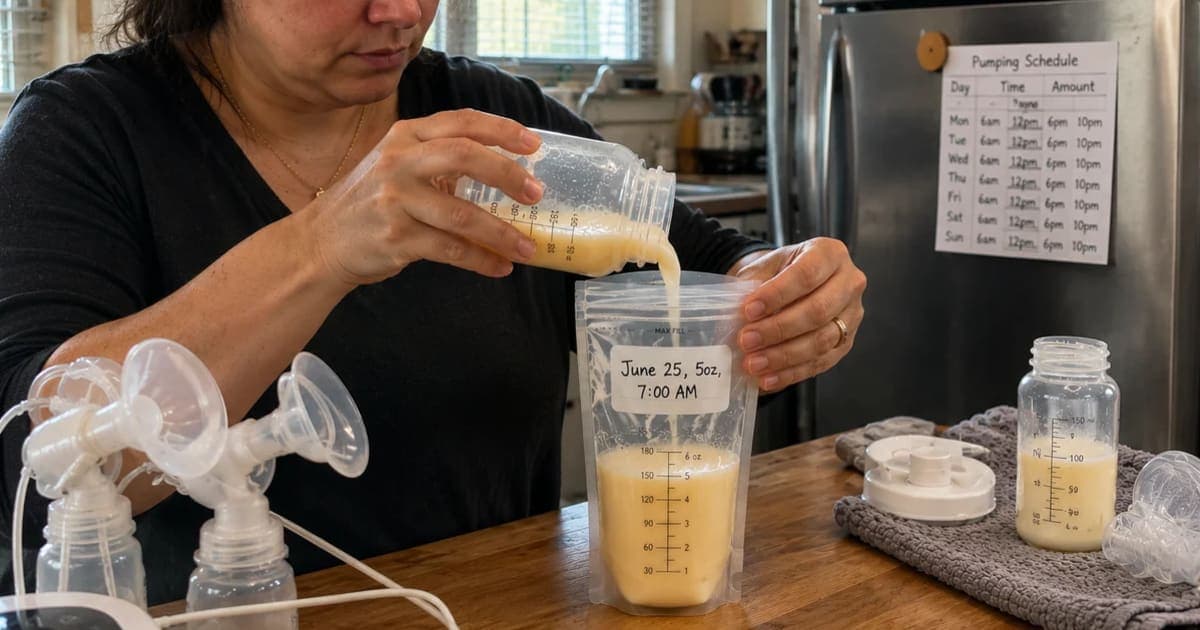
If nursing alone isn't enough, pump for 10–15 minutes after your baby finishes. Even if you get almost nothing at first — that's fine. The stimulation is the point, not the output. You're placing an order your body hasn't received yet.
The best time to add an extra pump? First thing in the morning. Prolactin runs highest in the pre-dawn hours, so your breasts typically have more to give between 5 a.m. and 8 a.m. Use a hospital-grade double electric pump for the strongest stimulation.
7. Eat Enough (Seriously)
Producing breast milk burns roughly 300–500 extra calories per day. If you're restricting your diet — intentionally or because you're too exhausted to eat — your body may scale back production to protect its energy reserves.
This isn't about eating specific "lactation foods." It's about eating enough, period. Three meals, two snacks, whatever you can manage. Keep granola bars and fruit near wherever you nurse. And stay hydrated — drink when you're thirsty, keep a water bottle within arm's reach during feeds. For detailed meal ideas, our pregnancy and postpartum nutrition guide covers everything from macros to smart snacking.
8. Add Lactation-Supporting Foods (But Be Realistic)
Oats, brewer's yeast, flaxseed, dark leafy greens, garlic, and sesame seeds show up on every "galactagogue" list. The honest truth? The formal research on most of these is thin. A few small studies suggest oats and flaxseed may have a modest effect, but none of this is anywhere close to conclusive.
That said — these foods are nutritious, cheap, and unlikely to cause harm. If a bowl of oatmeal in the morning makes you feel like you're doing something proactive, and it gets solid calories into you, that's a win even without a supply boost. Northwestern Medicine has a good breakdown of what a balanced breastfeeding diet looks like.
What I'd skip: expensive "lactation cookie" mixes sold at premium prices. The ingredients are fine, but you can make oatmeal cookies at home for a fraction of the cost.
9. Manage Your Stress (Yes, It Really Matters)
This sounds like a throwaway tip. It's not. Cortisol — your stress hormone — directly inhibits the oxytocin response. When you're anxious, tense, or in pain, your let-down reflex gets blunted. The milk is there, but it can't get out efficiently.
Some practical ideas that actually help: nurse in a quiet room with dim lights. Put your phone down for the first five minutes. Watch a show you like while pumping — distraction works. Ask your partner to handle one night feed with expressed milk so you can sleep a full stretch. Rest isn't a luxury; it's a supply strategy.
If you're feeling overwhelmed — beyond regular new-parent exhaustion — talk to someone. Postpartum mood disorders are common, treatable, and they absolutely affect breastfeeding.
10. Be Cautious with Early Bottles and Pacifiers
The old term was "nipple confusion," but what's really happening is flow preference. Bottles deliver milk faster and with less effort than the breast. Some babies — not all, but some — get used to that easy flow and then fuss at the breast because they have to work harder.
Most paediatricians recommend waiting until breastfeeding is well established (generally around 4–6 weeks) before introducing a bottle. If you need to supplement earlier for medical reasons, talk to your IBCLC about paced bottle feeding — a technique that slows the flow and mimics the breast more closely.
11. Get Professional Help Early
If supply is still lagging after trying these steps for a week or two, see a lactation consultant. Not next month. Now. The earlier you address a supply issue, the easier it is to fix.
An IBCLC (International Board Certified Lactation Consultant) is the gold standard — they hold hundreds of supervised clinical hours and can manage complex cases. Many hospitals offer free or low-cost consults in the first weeks after birth. Your insurance may cover visits too, so check before paying out of pocket.
A weighted feed — where your baby is weighed before and after nursing — tells you exactly how many ounces transferred. That one number eliminates the guesswork entirely.
Track your baby's feeds, wet diapers, and weight check-ins in a simple notebook or phone app for the first 2 weeks. When a lactation consultant asks "how often is baby feeding?" — you'll have actual data instead of a foggy "um, a lot?"
3 Popular Myths That Won't Help Your Supply
Myth 1: "Drink More Water to Make More Milk"
You've probably heard this a hundred times. And it sounds logical — breast milk is about 88% water, so more water in should mean more milk out, right?
Except research doesn't support it. Studies consistently show that drinking beyond your natural thirst does not increase milk volume. Your body is extremely efficient at prioritising milk production. It'll pull fluid from your own reserves before it shorts your baby.
Stay hydrated for your own health and energy. Drink when you're thirsty. But don't force-drink litres thinking it'll double your output. It won't.
Myth 2: "Take Fenugreek — It's a Guaranteed Boost"
Fenugreek is the most commonly recommended herbal galactagogue, and the research on it is lukewarm at best. Some small studies show a modest increase. Others show nothing. And a few report side effects: GI upset in mothers, fussy or gassy babies, and that distinctive maple syrup smell that follows both of you around.
If you want to try it, talk to your provider first — it can interact with blood thinners and diabetes medications. But don't rely on it as a fix. Frequency of feeding and effective milk removal will always outperform any supplement.
Myth 3: "If You Can't Pump Much, Your Supply Is Low"
This one causes so much unnecessary panic. Pump output is not the same as milk supply. Some women respond beautifully to a pump. Others — with perfectly adequate supply — barely get an ounce because their body just doesn't let down as well for a machine.
Your baby is a far more efficient extractor than any pump ever built. If your baby is gaining weight, producing enough wet diapers, and seems content after feeds, your supply is likely fine regardless of what the pump bottles say.
- Skipping night feeds to "catch up on sleep" (tanks prolactin)
- Strict feeding schedules instead of on-demand nursing
- Supplementing with formula without pumping to replace the missed feed
- Nursing on demand, especially in the first 6 weeks
- One power pump session daily for a week
- Skin-to-skin before meals to prime the let-down
When to Call Your Doctor
Most supply dips are temporary and respond well to the strategies above. But see your healthcare provider if:
- Your baby hasn't regained birth weight by 2 weeks old
- Fewer than 6 wet diapers per day after day 5
- Your baby seems lethargic, unusually sleepy, or difficult to wake for feeds
- Signs of dehydration: sunken fontanel, dry lips, dark urine
- You've had breast surgery, thyroid issues, PCOS, or significant postpartum blood loss — these can affect supply through separate pathways
And one more thing worth saying out loud: supplementing with formula does not mean you've failed. If your baby needs more than your body can produce right now, feeding them is always the right call. "Fed is best" isn't a slogan — it's a baseline.
Baby-Led Weaning First Foods — What to Serve, How to Start, and What to Skip
Sources
- Cleveland Clinic — How Lactation Works
- AAP — Breastfeeding and the Use of Human Milk (Policy Statement)
- National Institutes of Health — Oxytocin and Skin-to-Skin Contact
- Mayo Clinic — Low Milk Supply: Causes and Solutions
- WHO — Breastfeeding Recommendations
- La Leche League / ILCA — Find a Lactation Consultant
- NIH LactMed — Fenugreek
This article is for informational purposes and does not replace medical advice. Consult your healthcare provider or a certified lactation consultant with specific concerns about breastfeeding.
From ovulation tracking and due dates to baby names and growth charts. Everything you need for your journey.
Share this post
Frequently Asked Questions
Related Topics
Contents
About the Author
Medically Reviewed By

Browse our curated baby name collection
Get the latest parenting tips and updates delivered to your inbox.
Read Next
Exclusive Pumping: Schedules, Supply Tips & What No One Tells You
Month-by-month pumping schedules, supply tips backed by evidence, equipment that matters, and the honest emotional advice no exclusive pumping guide gives you.
Read Article
Combo Feeding Your Newborn: How to Mix Breast Milk and Formula Safely
How to combo feed your newborn safely — with sample schedules by age, milk supply protection tips, mixing guidance, and honest answers to every question new parents ask.
Read Article
Baby Reflux: Normal Spit-Up, Silent Reflux Signs, and When to Worry
Baby reflux is common, but GERD needs care. Learn normal spit-up vs reflux, silent reflux signs, safe remedies, sleep rules, and when to call your pediatrician.
Read Article
Breastfeeding Positions: 7 Holds for a Pain-Free, Deep Latch
Struggling with a painful latch? Discover 7 safe breastfeeding positions (like side-lying and football holds) that make nursing comfortable. Backed by lactation experts.
Read Article
Cluster Feeding: Why Your Newborn Feeds Nonstop and What to Do About It
Your newborn wants to nurse every 30 minutes and you're running on empty. Here's what cluster feeding actually is, how long it lasts by age, and the real strategies to survive it.
Read Article
Clogged Duct or Mastitis? How to Tell, and What to Do
How to tell a clogged milk duct from mastitis, what the 2022 guidance says to do (ice, not heat), when to call your doctor, and honest takes on cabbage leaves and home remedies.
Read Article