
Baby Milestones Month by Month: What's Normal, What's Not


Your cousin's baby waved bye-bye at nine months. Yours just turned ten months and waves at nothing, ever, no matter how theatrically you demonstrate. The tracking app pinged you about it this morning — cheerfully — and now it is nearly midnight and you are trying to work out whether that is a harmless quirk or something you should have caught weeks ago.
Here is the short version, before the spiral starts. Baby milestones month by month are the skills most babies show by a certain age across four areas: how they move, how they connect with people, how they communicate, and how they think. Across the first year the order is fairly predictable. The exact timing is not, and one late skill on its own almost never means something is wrong.
What follows is the whole first year, one month at a time, built on the milestones the CDC and the American Academy of Pediatrics actually use — plus the part most charts leave out: which delays are worth a call to your pediatrician, and which just mean your baby is taking the scenic route.
Key Takeaways
- Milestones come in four areas — movement, social-emotional, language, and thinking. Most babies hit them in a similar order, but the timing varies far more than any chart admits.
- The CDC updated its milestones in 2022. They now list what 75% of babies do by each age (not 50%), so reaching a milestone means your baby is genuinely on track — not merely average.
- Official CDC checkpoints in the first year fall at 2, 4, 6, 9, and 12 months. The in-between months are for watching progress, not passing tests.
- Crawling is no longer an official milestone. Plenty of healthy babies skip it entirely and go straight to pulling up, cruising, and walking.
- One missed milestone is rarely a problem. A lost skill, or several missed together, is the pattern worth flagging to your pediatrician early.
How Baby Milestones Actually Work (and What Changed in 2022)
A milestone chart can read like a pass-or-fail exam. It is not one. Every chart sorts skills into the same four groups, and once you can see those groups, the rest of this guide gets much easier to read:
- Movement (motor): rolling, sitting, reaching, the pincer grasp, pulling up to stand.
- Social and emotional: smiling back at you, knowing familiar faces, playing peek-a-boo.
- Language and communication: cooing, babbling, turning to your voice, first words.
- Cognitive (thinking): watching a dropped toy, looking for hidden things, banging two blocks together.
The CDC's milestones now describe the 75th percentile — the age by which at least 75% of children can do something — instead of the old 50th-percentile average, a shift it made with the American Academy of Pediatrics in 2022. For you, that quietly changes what the chart means: if your baby has reached a listed skill, they are keeping pace with most babies their age, not scraping in at the middle. The same revision cut more than half of the original 216 milestones and added checkpoints at 15 and 30 months, so that every skill still on the list is one where a delay is genuinely worth a closer look.
Two of those cuts caught parents off guard. Crawling came off the list completely — the evidence behind it was just too soft, since nobody defines crawling the same way, the timing swings wildly, and plenty of typically developing babies never crawl at all. "Walks alone" slid from 12 months to 15. Babies did not get slower; the old chart was simply frightening families whose kids were, in fact, right on track. The CDC's Learn the Signs. Act Early. milestones lay out every checkpoint, and the reasoning behind the changes is documented in a 2023 pediatric review of the update.
One more thing to hold onto: in the first year, the CDC only sets formal checkpoints at 2, 4, 6, 9, and 12 months — the ages that line up with well-child visits. The in-between months in this guide (1, 3, 5, 7, 8, 10, 11) are not tests your baby has to pass. They are here so you know what tends to show up as your baby builds toward the next real checkpoint.
Baby Milestones Month by Month: The 0–12 Chart
If you want the whole year at a glance — the baby milestones by month view to screenshot and come back to — start here. Then read the month that matches your baby for the detail behind each line.
| Age | Movement | Social & Language | CDC checkpoint? |
|---|---|---|---|
| 1 month | Lifts head briefly on tummy; jerky arm movements | Focuses on faces; startles at loud sounds | — |
| 2 months | Holds head up on tummy; smoother movements | Social smile; coos; calms to your voice | Yes |
| 3 months | Pushes up on forearms; bats at toys | Laughs; follows you across the room | — |
| 4 months | Holds head steady; pushes up on elbows | Coos back; chuckles; reaches for you | Yes |
| 5 months | May roll tummy-to-back; grabs at objects | Blows raspberries; mouths everything | — |
| 6 months | Rolls both ways; sits with support | Knows familiar faces; takes turns with sounds | Yes |
| 7 months | Sits briefly alone; passes toy hand to hand | Babbles (ba-ba, da-da); responds to name | — |
| 8 months | Sits steadily; may rock on hands and knees | Longer babble strings; stranger wariness | — |
| 9 months | Sits without support; gets into sitting | Babbles mama/dada; plays peek-a-boo | Yes |
| 10 months | Cruises along furniture; early pincer grasp | Waves; claps; understands "no" | — |
| 11 months | Stands briefly alone; points at things | Imitates sounds; a first word may appear | — |
| 12 months | Pulls up; cruises; neat pincer grasp | Says mama/dada with meaning; waves bye-bye | Yes |
Months 1–3: Reflexes, First Smiles, and Finding Their Hands
The first three months are less about doing and more about settling in. Your baby arrives running on reflexes — the startle, the grasp, the rooting that turns their head toward anything brushing their cheek. By month three, some of that gives way to movements they actually mean.
Month 1: Reflexes and Faces
A one-month-old spends the day eating, sleeping, and crying, and that is the whole job description. Vision is blurry past eight to twelve inches — which happens to be the distance to your face while feeding, not a coincidence. During tummy time they may lift their head for a second before it drops. If the crying feels relentless and you have run out of ideas, our guide on why a newborn won't stop crying works through the usual suspects. This first stretch is survival, for both of you.
Month 2: The First Real Smile (CDC Checkpoint)
Somewhere around six to eight weeks comes the moment that makes the sleepless nights recede a little: the social smile. Not the gassy half-grins of week one — a real smile, aimed at you, because you smiled first. By the two-month checkpoint, the CDC looks for a baby who calms when picked up, watches your face, makes sounds beyond crying, and holds their head up during tummy time. It is the first checkpoint where your baby starts smiling back at the world.
Month 3: Cooing and Batting at the World
Head control gets noticeably stronger. On their tummy, many three-month-olds push up onto their forearms and hold it, taking in the room. Hands become fascinating objects in their own right, and swipes at a dangling toy start to land. The cooing turns conversational — vowel sounds, "aah" and "ooh," often aimed right at you and clearly waiting for a reply. Give them one. Those back-and-forth exchanges are the earliest scaffolding of language.

Around two months, the social smile and a steadier head during tummy time are the first big milestones — real progress, aimed right at you.
Months 4–6: Rolling, Reaching, and Sitting With Help
This is the stretch where your baby becomes a physical presence in the room. They roll, they reach with intent, they grab a fistful of your hair and pull. It is also when many families start eyeing the high chair.
Month 4: Steady Head, Belly Laughs (CDC Checkpoint)
What are the four-month milestones parents ask about most? By the CDC's four-month list, a baby holds their head steady without support when held, pushes up onto their elbows during tummy time, holds a toy you place in their hand, brings their hands to their mouth, and coos back when you talk. The big social one, echoed in Mayo Clinic's 4-to-6-month milestones: a real laugh, the kind that makes you do something ridiculous six more times just to hear it again.
Month 5: Rolling and Grabbing
Around now, many babies pull off their first roll — usually tummy-to-back, since it is easier. Reaching turns precise: they spot a toy, aim, grab, and send it straight to the mouth, because the mouth is how a five-month-old investigates everything. Raspberries and squeals join the soundtrack. This is prime time for tummy time, which builds the neck, shoulder, and core strength behind sitting and crawling — and if your baby protests it, as most do, our tummy time alternatives keep the strengthening going without the screaming.
Month 6: Sitting Up and First Foods (CDC Checkpoint)
So what milestones should a baby reach by six months? Most roll in at least one direction, push up on straight arms during tummy time, bring everything to their mouth, take turns making sounds with you, and light up for familiar faces. On sitting — the question every parent asks — six months is usually sitting with support or propped on their own hands; sitting up unsupported is a nine-month skill, so do not worry if they still topple. Six months is also the green light most pediatricians give for solids. If you are weighing purees against finger foods, our guide to baby-led weaning and first foods lays out both paths.

By six months, most babies sit with support and reach with purpose. Sitting up unsupported usually comes a few months later, around nine months.
Months 7–9: Sitting Solo, Babbling, and the Crawling Question
The second half of the year is louder and faster. Your baby sits without a spotter, babbles in a way that sounds almost like words, and discovers that you still exist even when you leave the room — a realization that tends to arrive with tears.
Month 7: Transferring and Babbling
Sitting gets sturdier, often a few seconds fully alone before the slow tip sideways. Objects begin passing from one hand to the other, which sounds minor and is actually a real cognitive leap. Babble picks up consonants — "ba," "da," "ga" — strung into little run-on sentences addressed to the dog, the ceiling fan, you. Many babies also start working out how to cross a room now, whether by scooting, rolling, or an army-crawl shuffle.
Month 8: On the Move
Lots of eight-month-olds get onto their hands and knees and rock back and forth, loading the spring before they launch. Object permanence is clicking into place — hide a toy under a cloth and they will hunt for it, where a month ago it simply ceased to exist. This is also when stranger wariness can surface, and the baby who beamed at everyone suddenly buries their face in your shoulder at the sight of Grandma. It is a sign of healthy attachment, not a change of heart.
Month 9: Sitting Solo and the Truth About Crawling (CDC Checkpoint)
By the CDC's nine-month checklist, the milestones are: sits without support, gets into a sitting position, babbles strings like "mamama" and "bababa," plays back-and-forth games like peek-a-boo, and looks over when you call their name. Notice what is missing: crawling. When do babies start crawling? Those who do usually manage it between six and ten months — but crawling was dropped from the milestones entirely, because it is too variable and some healthy babies skip it and go straight to cruising. What matters at nine months is that your baby is moving to explore somehow, and bearing weight on their legs when you hold them upright.
Months 10–12: Pulling Up, First Words, and Maybe First Steps
The finish line of the first year looks a lot like the start of toddlerhood. Your baby pulls up on the coffee table, works out that a wave means goodbye, and may hand you a first real word.
Month 10: Cruising and the Pincer Grasp
Furniture becomes a handrail. Ten-month-olds pull to standing and cruise sideways along the couch, and the pincer grasp — thumb and forefinger — sharpens enough to pick up a single puff of cereal, which they then examine like a jeweler. Gestures arrive with intent: waving, clapping, lifting both arms to be picked up. Many begin to understand "no," even if honoring it is years away.
Month 11: Pointing and First Words
Cruising gets confident, and some babies let go to stand alone for a wobbly second or two. Pointing shows up — first to demand the thing they want, later just to show you something interesting, which is a bigger communication milestone than it looks. A first word may surface here: "mama," "dada," "baba," or something only your household understands. They imitate everything now, sounds and gestures alike, so mind your language.
Month 12: Happy Birthday (CDC Checkpoint)
At the one-year checkpoint, the CDC looks for a baby who pulls up to stand, walks holding onto furniture, uses a neat pincer grasp, says at least one word like "mama" or "dada" with meaning, waves bye-bye, and searches for a toy they watched you hide. Walking, notably, is not required — that milestone now sits at 15 months, so a one-year-old who is cruising but not stepping solo is squarely on track. What comes next is a language explosion; our guide to 2-year-old speech red flags covers what to expect, and what to watch for, in the year ahead.
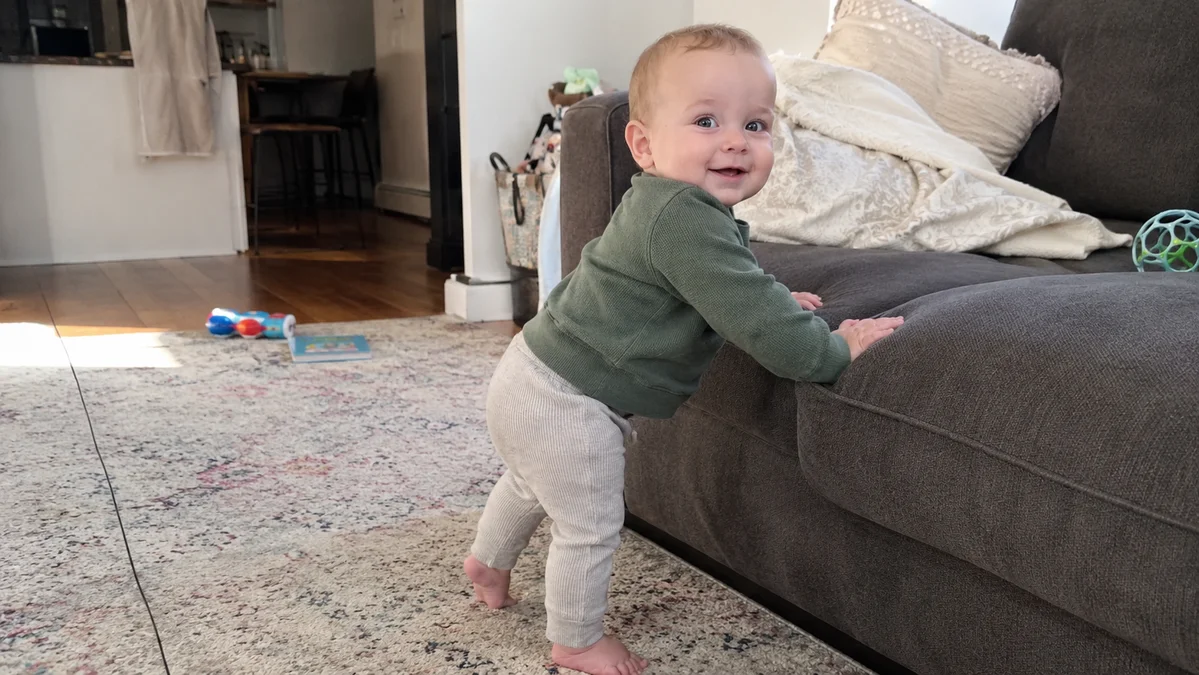
Pulling up and cruising along furniture are the twelve-month checkpoint. Walking solo is not required yet — that milestone moved to 15 months.
Developmental Red Flags: When to Call Your Pediatrician
Most of what worries parents falls inside the normal range. Some things do not, and this is the section to act on rather than file away. Call your pediatrician — do not wait for the next scheduled visit — if you notice any of these:
- Loss of a skill your baby already had — babbling that stops, a wave that disappears
- A body that seems very stiff, or very floppy
- Eyes that do not follow moving objects or meet yours
- No response to loud sounds, or to their own name by nine months
- No smiling at people by three months
- Not sitting with help by nine months, or not bearing weight on the legs
- No words, gestures, or pointing by twelve months
A baby who is a little late to a milestone is usually just a baby on their own schedule. A baby who loses a skill they already had — who stops babbling, stops waving, stops making eye contact — is a different situation, and it warrants a prompt call regardless of age. Regression is the single pattern pediatricians most want to hear about early. The CDC's own guidance is blunt: don't wait and see. Early support does the most good when it starts early.
If a milestone is missed, you are not asking for a diagnosis over the phone — you are asking for a developmental screening, a standard, structured check your pediatrician can do or refer for. The 9-month, 18-month, and 30-month visits include one by default. Bring specific examples ("she isn't turning to her name," not "she seems behind"), and trust your gut. A parent's instinct about their own baby is real clinical information, and good pediatricians treat it that way.
Premature Baby Milestones and Adjusted Age
If your baby was born early, read every milestone in this guide against their adjusted age — their age counted from the due date, not the birth date — right up until about age two, as the American Academy of Pediatrics advises. To find it, subtract the number of weeks your baby was born early from their current age. A baby born eight weeks early who is six months old today has an adjusted age of four months — so you would expect four-month skills, not six-month ones, and that is exactly on target.
This one adjustment clears away a huge amount of unnecessary panic. A premature baby who looks "behind" on a standard chart is very often right where they should be once you count from the due date. Most preemies catch up to their peers by their second birthday, though babies born very early or with medical complications can take longer and are usually followed more closely by their care team. Track the adjusted age, mark progress against it, and bring the same specific observations to your pediatrician if something genuinely stalls.
How to Support Your Baby's Development (Without Flashcards)
You cannot rush a nervous system, and you do not need to buy anything. Development in the first year runs on a few unglamorous things, repeated often. Talk to your baby constantly — narrate the grocery unpacking, name the dog, describe the weather. That running commentary, more than any app, builds the vocabulary they unpack months later. Read together, even to a four-month-old who mostly wants to eat the book. Give them floor time and tummy time instead of long stretches in bouncers and seats, because motor skills come from moving. Respond when they coo and babble, so they learn that communication earns a reply. That is genuinely most of it.
And the flashcards, the "baby genius" videos, the late-night searches for signs of high IQ in babies? Skip them. There is no reliable way to spot future intelligence in an infant, and hitting milestones early does not predict it — a baby who walks at nine months is not smarter than one who walks at fourteen, just earlier to that one skill. Warm, responsive, talk-filled ordinary days do more for a developing brain than anything marketed to accelerate it.
If your family spans two continents, you probably field a running commentary on all of this — an aunt certain that you were walking by nine months, a WhatsApp group where every cousin's baby is apparently a prodigy. Some of that is love; some of it is pressure you can set down. Two things worth knowing: milestones vary as much across families as the memories of them do, and if you are raising your baby with more than one language, you count words across both languages, not each separately. A baby who says three words in Urdu and two in English has a five-word vocabulary and is doing beautifully. Bilingual babies are not behind, and raising them with both languages is a gift, not a delay. You can nod along with your mother-in-law and your pediatrician in the same afternoon.
Baby Hates Tummy Time? Alternatives That Still Build Strength
If you take one thing from all of this, make it this: the chart is a map, not a verdict. Watch the direction your baby is heading, not the exact date they arrive. Steady forward progress — new skills stacking on old ones, month after month — is the real signal, and it matters far more than any single line item. As your baby grows past this first year and the questions shift from milestones to growth, our child height predictor is a lighthearted peek at what is ahead. And on the night an app pings you about a wave your baby hasn't figured out yet, you now know the difference between a scenic route and a wrong turn. Most of the time, it is the scenic route.
Sources
- CDC — Learn the Signs. Act Early. (Developmental Milestones)
- CDC — Milestones by 9 Months
- American Academy of Pediatrics (HealthyChildren.org) — Corrected Age for Preemies
- Mayo Clinic — Infant Development: Birth to 3 Months
- Learn the Signs. Act Early.: Updates and Implications (2023 peer-reviewed review of the CDC/AAP milestone revision)
This article is for general information and does not replace medical advice. Milestone ranges are guides, not deadlines. Always share concerns about your baby's development with your pediatrician, who can perform a developmental screening — especially if your baby was born prematurely, has lost a skill, or has a health condition.
From ovulation tracking and due dates to baby names and growth charts. Everything you need for your journey.
Share this post
Frequently Asked Questions
Related Topics
Contents
About the Author
Browse our curated baby name collection
Get the latest parenting tips and updates delivered to your inbox.
Read Next

Toddler Hitting and Biting: Why It Happens & How to Stop It Without Shaming
Toddler hitting and biting can be normal, but it still needs a firm response. Learn why it happens, what to say, and when to call the doctor.
Read Article
Toddler Sleep Regression at 18 Months and 2 Years: What’s Real and What Helps
Your toddler was sleeping through the night — now they’re not. What’s behind the 18-month and 2-year sleep regressions, how long they last, and the strategies that actually work.
Read Article
When Do Babies Start Crawling, Rolling Over, Sitting Up, and Walking?
When do babies roll over, sit up, crawl, and walk? Learn the real developmental milestone timelines, stages of crawling, CDC checklist updates, and red flags.
Read Article
Baby Growth Spurts: Ages, Signs, Feeding Frenzies & When to Worry
Baby feeding nonstop, fussing, or waking more than usual? Learn the common growth spurt ages, signs, duration, and red flags that mean it is time to call the doctor.
Read Article
Baby Reflux: Normal Spit-Up, Silent Reflux Signs, and When to Worry
Baby reflux is common, but GERD needs care. Learn normal spit-up vs reflux, silent reflux signs, safe remedies, sleep rules, and when to call your pediatrician.
Read Article
Baby Hates Tummy Time? 8 Pediatric-Backed Alternatives (That Actually Work)
Does your baby scream through every tummy time session? Don't force it. Try these 8 pediatric-backed alternatives that build the exact same strength without the meltdown.
Read Article
Potty Training Regression: Why It Happens at Every Age and How to Fix It
Your toddler was using the potty like a champ — then stopped. Here's what's behind potty training regression at every age, and the calm, step-by-step approach that gets things back on track.
Read Article
2-Year-Old Speech Red Flags: When to Worry (And When Not To)
Worried your 2-year-old isn't talking enough? Real red flags, normal variations, the late talker myth, and 5 daily habits that actually help — from a parent who's been in your shoes.
Read Article
When Do Babies Start Teething? Signs, Timeline, and Remedies That Actually Work
When do babies start teething, and how do you tell if it's teething or something else? A month-by-month eruption chart, real symptoms to watch, safe remedies, and the FDA warnings most sites skip.
Read Article