
2-Year-Old Speech Red Flags: When to Worry (And When Not To)

So your kid turned two last week. Or last month. And sometime between the cake and the clean-up, you opened your phone and started Googling "how many words should a 2 year old say" — probably at some ridiculous hour when everyone else in the house was asleep. Now you're down a rabbit hole. I get it.
I remember standing at a playdate watching a kid — same age as mine — ask his mom for a "blue cup please" while my son just... pointed. And grunted. My stomach dropped. Here's what I wish someone had told me that afternoon: speech at two is all over the map. Like, genuinely chaotic. One kid talks early, another barely says five words and ends up totally fine. But the internet doesn't tell you that part. Most articles either make you think the sky is falling or tell you not to worry at all.
Not helpful, right? So I wrote the thing I wish had existed when I was in your shoes. The actual red flags that would make a speech therapist raise an eyebrow — and also the stuff that looks scary at 2am but really isn't. Plus what you can do about it starting tomorrow. Not a textbook. Not a guilt trip. Just the stuff I needed to hear and couldn't find anywhere.
What Should a 2-Year-Old's Speech Actually Look Like?
First thing — let's figure out what "on track" even means at this age. Because honestly, the range of normal at 24 months is way wider than any milestone chart makes it look.
The Numbers That Actually Matter
I went through the ASHA guidelines and the CDC's 2-year milestone list so you don't have to. Stripped out the clinical language. Here's the version you'd actually tape to the fridge:
| Skill | What It Looks Like |
|---|---|
| Vocabulary | Around 50 words minimum (some kids are at 200+, don't panic if yours isn't) |
| Word combinations | Sticking 2 words together — stuff like "more milk" or "daddy go" or "big truck" |
| Following directions | Can follow "give me the ball" or "come here" without you miming it |
| Pointing | Points at stuff in books, shows you their nose when you ask "where's your nose?" |
| Intelligibility | You understand about half of what they say; strangers might catch less |
| Gestures | Uses more than just waving — nods yes, blows kisses, reaches for things |
Quick note on that "50 words" number — it's a floor, not a goal. My friend's daughter had close to 200 words at two. My son had maybe 40. Both turned out fine. What mattered more than the count was whether new words kept showing up each week. That growth trend? Pay attention to that.
Why "Normal" Has a Wide Range
Kids who spend all day with a chatty older sibling sometimes talk later — they don't need to, because someone else does it for them. Firstborns, on the other hand, often talk earlier since they get more one-on-one adult interaction. And then there's personality — which no milestone chart accounts for. I've watched toddlers sit at the edge of a playgroup for weeks, completely silent, taking it all in like tiny anthropologists. Then one Tuesday they open their mouth and out comes a full sentence. They weren't behind. They were loading. None of this is a red flag on its own.
Curious about your child's growth trajectory in other areas? Our Child Height Predictor can give you an estimate of how tall they might eventually be.
The Real Red Flags — Signs That Deserve Attention
Alright — this is probably why you're here. I'm going to go through what SLPs actually pay attention to during an evaluation. But before you start mentally checking boxes and spiralling: one of these on its own? Probably nothing. It's when three or four of them show up together that you want to grab your phone and call somebody.
Watch For These at 24 Months
- Fewer than 50 words — and the number isn't growing week to week.
- No two-word combinations — not even "more juice" or "bye-bye daddy."
- Doesn't follow simple directions without you pointing or gesturing.
- Rarely imitates sounds or words — not even trying to copy what you say.
- Prefers gestures over words — consistently pulls you by the hand instead of asking.
- Gets visibly frustrated when trying to communicate — tantrums because they can't get the words out.
- Losing words they used to say — this one is a big deal. Regression always warrants a call to your doctor.
- You say their name and... nothing. Not "they're ignoring you because Bluey is on" — genuinely doesn't turn around or look up, even in a quiet room.
- Not really interested in people. Doesn't look at you when something exciting happens, doesn't do that back-and-forth babble thing where they "talk" and then wait for you to respond.
- Their voice sounds... off. Always nasal, or raspy, or like they're whispering even when they're not. If it's been that way for weeks and it's not a cold, mention it to your doctor.
Counting up more than 2 or 3 of those? Pick up the phone. Call your paediatrician. Ask for a referral. Here's what most people don't realise: the absolute worst thing that happens if you get them checked early is that someone says "they're fine, here are a couple of tips" and sends you home. That's... a pretty good worst case, right?
When NOT to Worry (Seriously, Take a Breath)
This section doesn't exist on most of the parenting sites you've been reading, and I think that's a problem. Not every quiet toddler has a speech delay. Here are the situations that look worrying but usually aren't:
- They understand everything you say but don't say much back. Comprehension running ahead of expression is common and actually a good sign. The words are building up in there — they just haven't come out yet.
- Your family speaks two languages. I hear this one constantly from parents in bilingual homes: "Maybe the two languages are confusing him." Nope. That's a myth, and ASHA has been crystal clear about it. Your kid might know 25 words in English and 25 in Spanish — but add those together and they're right at 50. And that thing where they mix both languages in one sentence? Totally normal. Linguists actually have a word for it: code-switching. It means their brain is processing two systems at once, which is impressive, not worrying.
- Big brother or sister does all the talking. If you've got a five-year-old who announces what the baby wants before the baby even opens their mouth — yeah, that's going to slow things down. Why would they bother talking when they have a built-in translator? This is a really common second-child thing and it usually sorts itself out.
- They were born premature. If your child was a preemie, use their corrected age (adjusted for how early they arrived) when measuring milestones. A baby born 8 weeks early is effectively 8 weeks younger developmentally.
- They babble with purpose and use gestures. A toddler who points at things, makes eye contact, and babbles with the rhythm and inflection of real speech? They're practising. The actual words are coming.
- They had recurrent ear infections. Fluid in the middle ear muffles sound. If the infections have resolved and hearing is back to normal, speech often catches up quickly on its own.
Here's the thing nobody tells you at the paediatrician's office: the raw word count matters less than the direction it's going. A kid who said 10 words in January and now says 35 in March? They're gaining speed. A kid who has been hovering around 10 words since November? That's a different story.
"Late Talker" vs Speech Delay — They're Not the Same Thing
Every parenting group has that one person who says, "My nephew didn't say a word until he was three. Now he won't shut up!" Those stories exist. They're not made up. But they're also not the full picture, and leaning on them too hard can mean missing a window where early help would have made a real difference.
So what actually is a "late talker"? The Hanen Centre — they're one of the go-to research groups on early language — uses a pretty specific definition. It's a kid between 18 and 30 months with fewer words than expected, but who seems fine in every other way. They follow directions, they play normally with other kids, they make eye contact and gesture. Roughly 1 in 8 two-year-olds fits this description.
Some of them catch up by three. Totally on their own. No therapy, no intervention, just — one day the words start pouring out. But (and this is the part your mother-in-law won't tell you) some don't. And there's no blood test or brain scan that tells you which camp your kid is in. That's exactly why the old "just wait and see" advice is losing ground with most SLPs these days. Getting checked doesn't hurt. Not getting checked might.
| Late Talker | Speech/Language Delay |
|---|---|
| Understands language well for their age | May struggle with both understanding and speaking |
| Plays and interacts normally with others | Social interaction may be limited or unusual |
| Uses gestures and has strong nonverbal cues | Fewer gestures or lack of pointing/showing |
| May catch up on their own by age 3 | Typically needs professional support |
What Could Be Behind the Delay?
If your kid genuinely has a speech delay — not the late-bloomer kind, but the kind where something's actually going on — there's usually a reason behind it. And it helps to have some idea what that reason might be before you walk into the paediatrician's office, so you're not just sitting there going "I don't know, he just... doesn't talk much?"
Hearing Issues
First question out of any SLP's mouth: "How's their hearing?" Makes sense when you think about it. If your kid's had ear infection after ear infection — my neighbour's son had six before he turned two, no joke — they've basically been hearing everything through water for months. Try learning French while someone holds a pillow over the speaker. That's what it's like for them. The NIDCD puts hearing at the top of the list for why toddlers fall behind.
Oral-Motor Difficulties
This one's sneaky and kind of heartbreaking. You can see it on your kid's face — they know what they want to say. The frustration is right there. But what comes out is garbled or nothing at all. Turns out, getting your tongue and lips and jaw to work together for one tiny word is ridiculously hard motor work (seriously, try saying "rural juror" five times fast and tell me it's easy). There's something called childhood apraxia of speech — basically the brain can't plan the mouth movements fast enough. Kids with it are sharp. They get everything. Their mouth just won't cooperate.
Too Much Screen Time
Yeah, I know. You don't want to hear this one. Neither did I. But a 2024 JAMA Pediatrics study put actual numbers on it: every extra minute a toddler spends staring at a screen is a minute they're not hearing you narrate breakfast or argue with the dog or badly sing the Bluey theme song — and those messy, unscripted, real-life exchanges are what actually wire their brain for language. The study found roughly 7 fewer adult words heard and 5 fewer babbling attempts from the kid per extra minute of screen time at 36 months. It's not that Cocomelon is poison. It's that a screen can't go "wait, what did you just say?" and lean in — and that back-and-forth — your kid says something, you respond, they try again — is how language gets built. The AAP says an hour or less of decent content a day for ages 2–5. Under 18 months? Skip it entirely. (FaceTime with grandparents doesn't count.)
Autism Spectrum — A Word on Context
I know where your brain went. You've already Googled it. Let me just say this: a speech delay by itself doesn't mean autism. Plenty of late talkers are neurotypical. And plenty of autistic kids talk just fine. What SLPs look for is the social stuff. Does your kid run up to show you a cool rock they found? When you point at something across the room, do they look where you're pointing? Do they play pretend — feeding a stuffed animal, making a truck talk? If that social back-and-forth is there and it's just the words that are lagging, autism is usually not what's going on. Still worth mentioning to your doctor. But don't lose sleep over it based on word count alone.
What to Do Right Now (Your Action Plan)
If you've made it this far and you're thinking "okay, I should probably do something" — here's the concrete path forward.
- Call the paediatrician. Don't wait for the 2-year check-up. Just call. Say what you're noticing (and what you're not hearing). Ask them to check hearing and to refer you to an SLP. Takes five minutes.
- Look up Early Intervention in your state. Every US state has a free program for kids under 3. Here's the wild part: you don't even need your doctor to refer you. You can call them yourself. And the evaluation is usually free.
- Get a proper SLP assessment. This is where a speech therapist sits with your kid (usually through play — it's not scary) and checks what they understand, what they can say, how clear their sounds are, and how their mouth moves. At the end, you'll know exactly where things stand. No more guessing.
- Start doing the daily habits I've listed below. Even if your kid doesn't need therapy — and I hope they don't — these are good for every toddler. Free, easy, and they work.
5 Daily Habits That Actually Move the Needle
I stole these from every SLP I've ever spoken to. No fancy toys needed. No apps. Just you talking to your kid a little differently during the stuff you're already doing — breakfast, bath time, getting dressed, whatever.
Try These Every Day
- Narrate everything you do. "I'm cutting the banana. Look — it's yellow! Now I'm putting it on your plate." This sounds silly. It works. You're pairing words with real, visible actions.
- Expand what they say. If your toddler says "car," you say "big red car!" or "the car goes fast!" You're giving them the next step without correcting them.
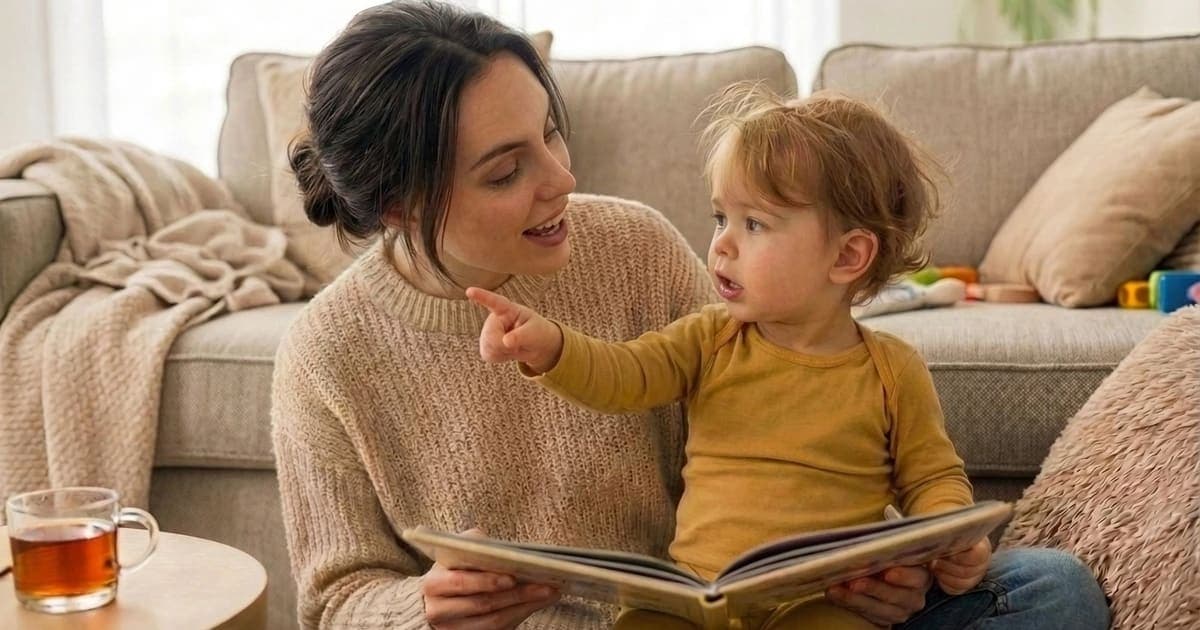
- Read together and pause. Point at pictures. Ask "what's that?" but don't drill them — if they don't answer, just say the word yourself and move on. The pressure-free exposure is what matters.
- Give them two options. Hold up an apple in one hand, banana in the other. "Which one?" They can't just point when both things are right there — they have to try saying something. Sneaky? Yeah. Effective? Also yeah.
- Sing songs with gaps. "Twinkle, twinkle, little…" and wait. Let the silence hang for a few seconds. You'll be amazed how quickly they start filling in the blanks.
Oh, and one more thing. I know it's tempting to hold up every object in the kitchen and go "what's this? Say it! Say spoon!" Please don't. I did that. My kid just stared at me like I'd lost my mind and then walked away. Two-year-olds can smell a quiz from a mile away and they want no part of it. Just... talk to them. During normal stuff. If the best they give you today is a grunt and a point — awesome. They communicated. Build on that.
The Part Nobody Talks About — Parent Guilt
Okay, real talk. I debated even putting this section in because it gets heavy. But I've read the comments. I've been in the Facebook groups at midnight. And the question that comes up over and over is some version of: "Is this my fault? Did I let them watch too much TV? Should I have read to them more?"
Stop it. Seriously. You didn't do this. Genetics, brain wiring, ear health, personality — your child's speech is shaped by a dozen things you never had a vote on. And the fact that you're sitting here reading this at whatever ungodly hour it is right now? You're not neglecting your kid. You're researching how to help them. That's literally the opposite.
I won't sugarcoat it — the playground comparison thing is rough. You're watching Emma string together sentences while your kid yells "NANA" and flings Goldfish at a stranger. It stings. But Emma talking earlier doesn't mean she's smarter, and your kid being quieter doesn't mean anything is broken. Three years from now they'll both be talking your ear off in the car and you'll wish for five minutes of silence.
Look, if something feels off — go with that feeling. Parents pick up on stuff that checklists miss. My only ask is that you don't just sit with the worry. Call the doctor. Book the eval. Let someone who does this every day take a look. If they say your kid's fine, you'll sleep better. If they say there's something to work on, you'll be glad you didn't wait. Either way, you did the right thing. That's not helicopter parenting. That's just... parenting.
Sources
- ASHA — Communication Milestones: 2 to 3 Years
- CDC — Milestone Checklist: 2 Years
- Mayo Clinic — Language Development: Speech Milestones for Babies
- Hanen Centre — How to Tell If Your Child Is a Late Talker
- National Institute on Deafness and Other Communication Disorders — Speech and Language
- AAP — Media and Children
- JAMA Pediatrics — Screen Time and Language Development (2024)
Quick disclaimer: I'm not your child's doctor or therapist. This article is here to help you think through what you're seeing, but it's no substitute for someone actually sitting with your kid and doing a real evaluation. If something feels off, please call your paediatrician or find an SLP near you.
From ovulation tracking and due dates to baby names and growth charts. Everything you need for your journey.
Share this post
Frequently Asked Questions
Contents
About the Author
Medically Reviewed By

Browse our curated baby name collection
Get the latest parenting tips and updates delivered to your inbox.
Read Next
Toddler Hitting and Biting: Why It Happens & How to Stop It Without Shaming
Toddler hitting and biting can be normal, but it still needs a firm response. Learn why it happens, what to say, and when to call the doctor.
Read Article
When Do Babies Start Crawling, Rolling Over, Sitting Up, and Walking?
When do babies roll over, sit up, crawl, and walk? Learn the real developmental milestone timelines, stages of crawling, CDC checklist updates, and red flags.
Read Article
Potty Training Regression: Why It Happens at Every Age and How to Fix It
Your toddler was using the potty like a champ — then stopped. Here's what's behind potty training regression at every age, and the calm, step-by-step approach that gets things back on track.
Read Article
Screen Time for Kids by Age: What the AAP Actually Recommends (And a Family Plan That Works)
How much screen time is too much? AAP and WHO guidelines broken down by age, a family media plan you'll actually use, and the warning signs most parents miss.
Read Article
How to Discipline a Toddler Without Yelling — 10 Gentle Parenting Strategies That Actually Work
Tantrums, hitting, meltdowns — 10 gentle parenting strategies that replace yelling with connection. Includes real scripts, a 'what to say instead' table, and the brain science behind why it works.
Read Article
Montessori at Home Without Expensive Toys: A Realistic Parent Guide
Start Montessori at home without expensive toys using real-life routines, simple shelf setup, safe activities, and age-by-age ideas.
Read Article