
Signs of Labor: How to Know It's Really Time (And When to Go In)


It's 11:40 at night, you're 38 weeks pregnant, and you've been timing contractions with an app you downloaded twenty minutes ago. Eight minutes apart. Then eleven. Then six. Every list of the signs of labor you've read tonight ends with the same maddening disclaimer — every labor is different — which is true, and also zero help when you're deciding whether to wake the whole house.
So let's be more useful than that. One thing decides this question, and it's the thing a triage nurse will ask about before anything else: the pattern of your contractions. Everything else — the mucus plug, the backache, the sudden 1am urge to reorganize the nursery — is context. Sometimes meaningful context. A green light on its own, almost never.
Key Takeaways
- True labor contractions get longer, stronger, and closer together — and they keep coming when you rest, drink water, or change position. False labor rarely survives that test.
- The 5-1-1 rule: contractions every 5 minutes, lasting 1 full minute, for at least 1 hour — the point where most US providers want you heading in. Some prefer 4-1-1; ask yours.
- Losing your mucus plug does not mean labor is imminent. It can happen days or even weeks early — and the plug can re-form.
- Only about 1 in 10 term pregnancies starts with the water breaking. If yours does, call your provider right away — even with no contractions at all.
- Skip every timing rule and call now for: bleeding, green or brown fluid, reduced baby movement, or regular contractions before 37 weeks.
What Are the First Signs of Labor?
The first signs of labor usually include contractions settling into a regular pattern, period-like cramps or a low backache, pink or blood-tinged discharge known as bloody show, and pelvic pressure as the baby drops. Loose stools and a sudden burst of nesting energy are common in the final day or two.
Doctors split labor's opening act into a latent phase — the cervix softening, thinning, and starting to open — and an active phase where everything speeds up. Nearly all the classic early signs belong to that latent phase, which can run hours or, unfairly, days. Here's what tends to show up first:
- Lightening. The baby drops deeper into your pelvis. Breathing gets easier, walking gets waddlier, and the bathroom trips multiply. In first pregnancies this can happen weeks before labor; in later ones, sometimes not until labor itself.
- Losing the mucus plug (bloody show). Extra discharge that's clear, pink, or blood-tinged — occasionally one thick blob. ACOG notes this can come days before labor starts, and Cleveland Clinic ob/gyns point out the plug can even re-form while labor stays weeks off. Interesting, not urgent.
- Cramps and low backache. Period-like cramping and a dull ache that parks itself in your lower back, coming and going over hours.
- Loose stools. The same prostaglandins that ripen the cervix wake up your gut. Unglamorous, and very common.
- A nesting surge. A sudden, specific energy to scrub, fold, and finish things — often in the last day or two.
- Cervical change at checkups. Late-pregnancy visits may come with numbers: effacement in percentages, dilation in centimeters.
One thing worth saying about those cervical checks: hearing "you're 1 centimeter" at 38 weeks tells you almost nothing about when labor will start. Some women walk around at 2 centimeters for weeks; others go from closed to holding a baby inside a day. If you're in your ninth month and collecting numbers at every visit, treat them as trivia until contractions give them context.

Most labor decisions happen like this — at night, phone in hand, counting minutes. The contraction pattern matters more than any single symptom.
Signs That Labor Is 24 to 48 Hours Away (and How Much to Trust Them)
Search this phrase and you'll find lists of ten, twelve, fifteen signs. Read them closely and a pattern emerges: the closer a sign sits to actual labor, the more it involves contractions. Everything else is weather forecasting.
That said, a few things genuinely do cluster in the final day or two. Contractions start organizing — still irregular, but no longer random. Cramps come and go over hours instead of minutes. Back pain settles in and stops responding to position changes. Loose stools show up, appetite dips, and some women drop one to three pounds as the body sheds water weight. Others get a restless, wired energy that has them alphabetizing the spice rack at midnight — the nesting cliché has some truth behind it.
And some women get none of it, then wake up in active labor. If your last prenatal visit left you unsure what's typical for your week, our pregnancy week-by-week guide covers what weeks 36 through 40 usually look like. But if you only have energy to track one thing, track whether contractions are forming a pattern. That's the tell.
True vs False Labor: The Table Worth Screenshotting
This is the comparison that settles most 2am debates. It's built on the criteria in ACOG's guidance on how to tell when labor begins — the same logic a triage nurse walks through on the phone.
| What to check | True labor | False labor (Braxton Hicks) |
|---|---|---|
| Timing | Regular intervals that get closer together | Irregular — no pattern, never tightens up |
| Strength | Gets steadily stronger | Stays weak, or fades in and out |
| Rest & movement | Keeps coming when you rest, walk, or change position | Often stops with rest, a walk, or a new position |
| Where it hurts | Often starts in the back and wraps to the front | Usually felt in the front only |
| After water + rest | Contractions continue regardless | Frequently settles down |
That last row is a test you can run right now: drink two big glasses of water, lie down on your left side, and rest for thirty to sixty minutes. False labor usually loses interest. True labor does not care how hydrated you are.
There's also a third category nobody warns you about: prodromal labor. Cleveland Clinic describes contractions that are mildly painful, arrive about every five minutes, last around a minute — and then simply refuse to progress, sometimes for days near full term. It's false labor with excellent production values, and it's exhausting. Rest, fluids, a warm shower, and position changes are the standard management; the pattern that never intensifies is your reassurance that it isn't the real thing yet.
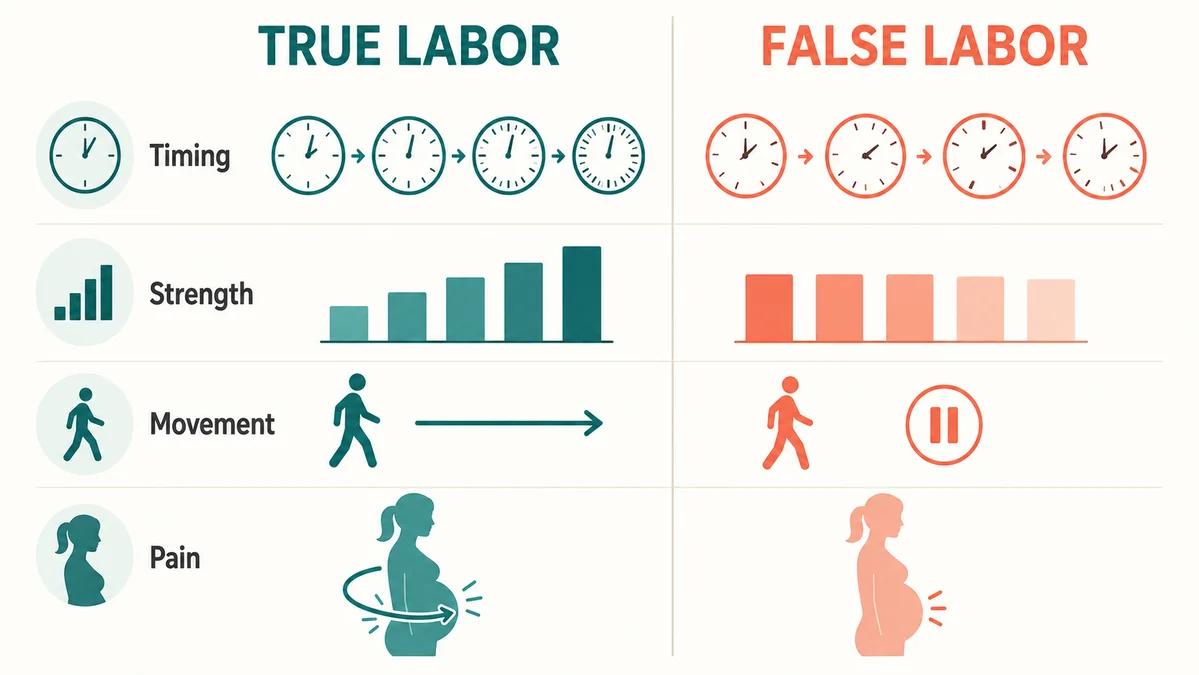
True labor builds and keeps building. False labor is irregular, front-only, and usually backs off when you rest or change position.
How to Know You're Really in Labor: The Three-Question Check
Strip everything above down to three questions:
- Are they getting closer together? Time six contractions in a row — start to start — and compare the first gap to the last.
- Are they getting stronger? The talk test is crude but effective: if you can chat through a contraction, it's early or false. Once you have to stop and breathe, pay attention.
- Do they keep coming no matter what you do? Run the water-and-rest test from the table above. Contractions that survive it mean business.
Three yeses is labor until proven otherwise. Call your provider — sorting this out over the phone is a routine part of their job, not an imposition on it.
Can Labor Start Without Contractions? (Silent Labor)
Yes, occasionally. In what's often called silent labor, the cervix thins and dilates without contractions strong enough to register — some women feel only gas-like pressure or a pulsing low backache, and a few discover at a routine check that they're already 3 or 4 centimeters along. Honest caveat: hard data here is thin, partly because silent labor is usually identified after the fact, though it's reported more in second and later pregnancies. If you're past 36 weeks with persistent pelvic pressure or rhythmic tightening that doesn't exactly hurt, mention it to your provider. That vague-but-real symptom is precisely what cervical checks exist for.
Can Your Water Break Without Contractions?
Yes — often enough that it has its own acronym. Prelabor rupture of membranes (PROM) occurs in roughly 8 to 10 percent of term pregnancies, and about 70 percent of those women start contracting on their own within 24 hours. Forget the movie version, too: ACOG describes it as a trickle or a gush, and a slow leak you're not quite sure about is at least as common as the dramatic splash.
Whatever it looks like, call your provider the moment it happens — even with zero contractions. Note the time, the color, and any odor before you dial. Once that seal is broken, infection risk climbs with the clock, which is why NHS guidance offers induction if labor hasn't started within about 24 hours of the waters going. This is the one early sign with no wait-and-see option.
The 5-1-1 Rule, Explained (It's Not the "5-5-1 Rule")
The 5-1-1 rule says to head to the hospital when contractions come every 5 minutes, last 1 full minute each, and have held that pattern for at least 1 hour. Some providers prefer a 4-1-1 or even 3-1-1 version, especially for second babies — ask yours which numbers they want you to use.
You'll also hear it garbled as the "5 5 1 rule," which doesn't exist — the middle number is one minute of contraction length, not five. And it helps to know why the rule is shaped this way. The American College of Obstetricians and Gynecologists defines active labor as beginning around 6 centimeters of dilation, and home-timing rules like 5-1-1 exist to get you to the hospital close to that point rather than long before it. Arriving during early labor usually earns you a walk around the parking lot or a trip back home — not because anyone doubts you, but because early labor genuinely goes better where your own shower and pillows are.
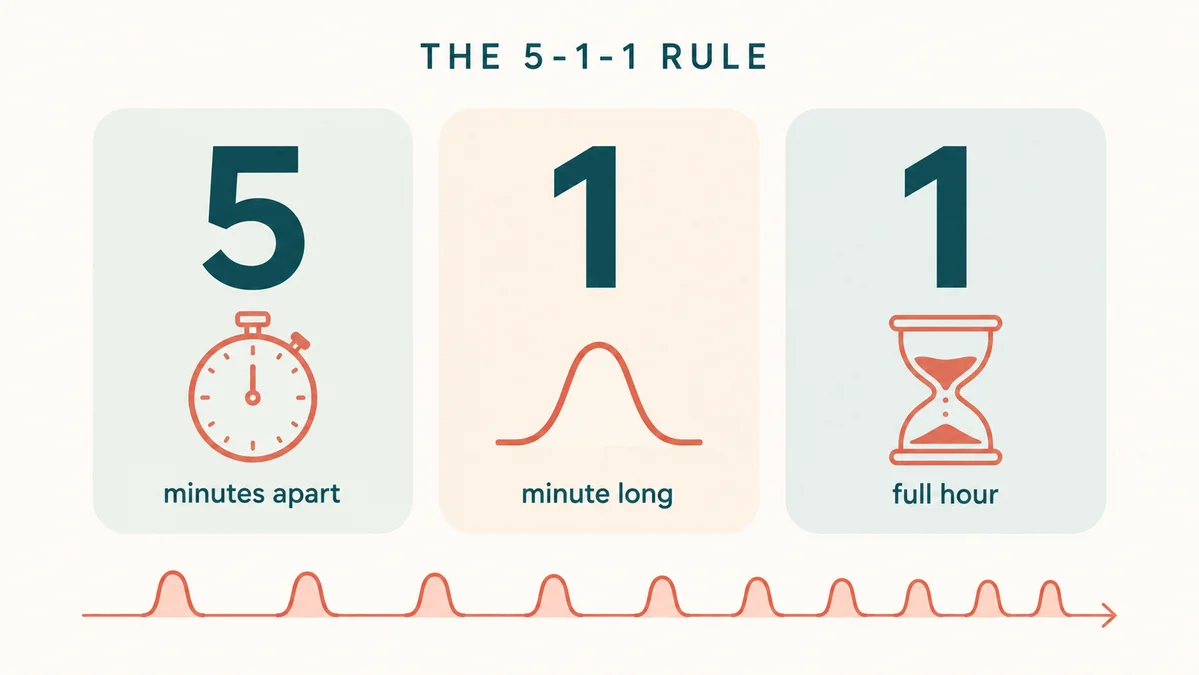
5-1-1: every 5 minutes, 1 minute long, for 1 hour. Time contractions from the start of one to the start of the next.
For calibration while you count: early-labor contractions typically run 30 to 70 seconds and arrive 5 to 15 minutes apart, per Cleveland Clinic; by active labor they're closer to every 3 minutes. Always time start-to-start, not end-to-start — it's the most common counting mistake.
A note for families whose advice spans continents: if your mother gave birth under the NHS, she may swear you call the moment contractions are regular and five minutes apart — because that is exactly what the UK system teaches, with urgent escalation at six contractions in ten minutes. An American provider teaching 5-1-1 isn't contradicting her; the two systems draw the come-in line at slightly different points. Use your own provider's numbers, and hand the family the actual rule so everyone stops relitigating it over WhatsApp.
When to Go to the Hospital — and When to Call Right Now
The 5-1-1 pattern covers the normal road in. These situations skip every timing rule. Call your provider or head in — day or night — if:
- Your water breaks — note the time and color, and call even without contractions
- The fluid is green, brown, or foul-smelling — this needs assessment promptly
- You're bleeding more than light pink spotting
- Your baby's movements have slowed or changed noticeably
- You're having regular contractions before 37 weeks
- The pain is constant and severe instead of coming in waves
- You have a severe headache, vision changes, or sudden swelling in your face or hands
Everything in this article about waiting, timing, and water-and-rest tests assumes you're at term. Regular contractions, cramping, pelvic pressure, or fluid leaking before 37 weeks is possible preterm labor — call your provider immediately rather than timing anything. Caught early, preterm labor can often be slowed or stopped.
And if you go in and get sent home? That's a successful trip, not an embarrassing one. Labor and delivery triage would rather check you twice than meet you in the parking lot, and nobody there is rolling their eyes — deciding exactly this question is most of what triage does all night.
What Labor Signs Can't Tell You
Start with the one that every South Asian family group chat has debated at least once: whether labor pain feels different with a boy or a girl. "Baby boy labour pain symptoms" gets searched thousands of times a month, and the honest answer is that they don't exist — no study has found any difference in labor pain, timing, or symptoms based on the baby's sex. Back labor, the usual "evidence" for a boy, is about the baby's position (facing your belly instead of your spine), not who's in there. Enjoy the aunties' predictions at the dinner table; leave them out of triage decisions.
The signs also can't tell you the date, and neither can the calendar. ACOG defines early term as 37 through 38 weeks, full term as 39 through 40, and doesn't consider a pregnancy post-term until 42 weeks — meaning spontaneous labor is "on time" anywhere inside a five-week window. Your due date is the midpoint of that window, not a deadline, and our pregnancy due date calculator maps the range rather than pinning your hopes to a single square on the calendar.
So for the 11:40pm version of you, the decision tree is shorter than the anxiety: any red-flag symptom — go now. Water broken — call now. Contractions at 5-1-1 — go. Anything less — water, left side, one hour, then reassess. And since labor is the bridge and not the destination, when you're ready to think past it, our postpartum recovery timeline covers what the first six weeks on the other side actually feel like.
Sources
- ACOG — How to Tell When Labor Begins
- Cleveland Clinic — 10 Signs Labor May Be Beginning
- Cleveland Clinic — Prodromal Labor
- StatPearls (NCBI) — Preterm and Term Prelabor Rupture of Membranes
- NHS — Signs That Labour Has Begun
- Mayo Clinic — Signs of Labor: Know What to Expect
This article is for general information and does not replace medical advice. Labor decisions are exactly what your OB, midwife, or maternity unit is there for — call them with any concern, at any hour, especially for bleeding, reduced movement, broken waters, or any symptom before 37 weeks.
From ovulation tracking and due dates to baby names and growth charts. Everything you need for your journey.
Share this post
Frequently Asked Questions
Related Topics
Contents
About the Author
Medically Reviewed By

Browse our curated baby name collection
Get the latest parenting tips and updates delivered to your inbox.
Read Next

C-Section Recovery Week by Week: What Really Happens Inside and Out
Your C-section recovery timeline week by week. Learn when pain peaks, how your body heals inside, sleeping positions and the honest recovery tips your discharge papers skipped.
Read Article
The Hospital Bag Checklist: What to Pack for You, Baby, and Your Partner
Pack your hospital bag by 36 weeks with essentials for mom, baby, and partner, plus C-section extras and what to leave home.
Read Article
Postpartum Depression vs. Baby Blues: How to Tell the Difference
Baby blues or postpartum depression? Here's how to tell the difference — real symptoms, a side-by-side comparison, when to call your doctor, and what treatment actually looks like.
Read Article
Pregnancy Weight Gain: How Much Is Normal? (Chart + Trimester Breakdown)
How much weight should you gain during pregnancy? A BMI-based chart with trimester breakdown, where the weight goes, and when to talk to your doctor.
Read Article
Pregnancy Exercises by Trimester: What's Safe, What Helps, and What to Skip
Which exercises are safe during pregnancy — and which should you skip? A trimester-by-trimester guide with ACOG-backed workouts and warning signs.
Read Article
Your Postpartum Recovery Timeline: What's Really Happening to Your Body Week by Week
Your body just did something extraordinary. Here's exactly what happens during postpartum recovery — from the first 24 hours through 6 months — for both vaginal and C-section births.
Read Article
Pregnancy Nutrition Guide: What to Eat, What to Avoid, and Why It Matters
Everything you need to know about eating well during pregnancy — 8 key nutrients with exact amounts, trimester-by-trimester guidance, foods to avoid, a sample meal plan, and common mistakes.
Read Article
How Much Does a Baby Really Cost? A First-Year Budget Breakdown
A no-nonsense breakdown of what a baby really costs in the first year — from childcare and birth bills to diapers, formula & the hidden expenses nobody warns you about. Includes 3 budget scenarios.
Read Article
Baby Milestones Month by Month: What's Normal, What's Not
The whole first year, one month at a time — the movement, social, and language milestones most babies hit, and the delays actually worth a pediatrician call.
Read Article