
How to Bathe a Newborn: Sponge Bath to Tub, Step by Step


The first time you bathe a newborn, your hands shake a little. They are smaller than you pictured, they turn slippery the instant water touches them, and they have strong opinions about the whole experience. Almost nobody learns how to bathe a newborn until there is a real one in front of them at home — a strange way to learn something that feels this high-stakes.
Until the umbilical cord stump falls off, you give a newborn sponge baths — the baby never goes in the water. After it heals, you switch to short, shallow tub baths. Three baths a week is plenty, the water should feel warm and not hot, and you never let go of your baby.
Key Takeaways
- Stick to sponge baths until the umbilical cord stump falls off — usually within one to two weeks. After that, shallow tub baths are safe.
- Three baths a week is enough for the whole first year. Daily bathing dries out a newborn's thin skin and is rarely needed.
- Keep the water warm, not hot — around 100°F (38°C), tested on your wrist, with no more than two inches in the tub.
- Touch supervision is non-negotiable: one hand stays on your baby for every second of the bath. Babies can drown in one to two inches of water.
- Skip soap most of the time. Warm water cleans a newborn fine; save mild, fragrance-free wash for the diaper area and genuinely dirty spots.
When Can You Give a Newborn Their First Bath?
There is genuinely no rush. The World Health Organization recommends waiting at least 24 hours after birth before bathing a newborn — or a minimum of six hours when that is not possible — to protect the baby's temperature, blood sugar, and earliest feeds. Most US hospitals have quietly moved in this direction over the past decade.
The clearest payoff shows up in breastfeeding. A Cleveland Clinic study led by nurse researcher Heather DiCioccio, which looked at close to 1,000 healthy newborns, found that delaying the first bath by at least 12 hours raised exclusive breastfeeding rates from 59.8% to 68.2%. One likely reason is scent — a freshly washed baby loses the familiar amniotic smell on their hands that helps them root toward the breast.
Here is the honest part most pages skip. A 2022 systematic review in the Journal of Global Health pooled 16 studies covering 39,020 newborns and pointed the same direction, but rated the evidence as low certainty. So waiting a day is sensible and almost certainly harmless — not a decision to agonize over. And at home, you are not on any clock at all. Sponge baths are fine from day one. If you are reading this before your baby has even arrived, you can map your timeline with our Due Date Calculator and add a soft basin and a hooded towel to the list now.
How to Bathe a Newborn: Sponge Bath or Tub?
One question decides which kind of bath your newborn gets: is the umbilical cord stump still attached? The American Academy of Pediatrics is blunt about it — give sponge baths only until the stump falls off, which usually happens within one to two weeks. Submerging the stump before then keeps it damp and slows healing, and a dry stump that drops off cleanly is the whole goal.
There is a second reason not to rush a full bath. That waxy white coating a newborn arrives in — vernix — is a natural moisturizer the AAP says may even have anti-bacterial properties. Letting it wear off on its own protects delicate skin in the first days. And if your son was circumcised, treat that the same way: sponge baths until the site has healed and your pediatrician gives the all-clear. The cord and the circumcision both follow one principle — keep healing skin out of standing water.
| Your Baby's Stage | Bath Type | Why |
|---|---|---|
| Cord stump still attached (first 1–2 weeks) | Sponge bath | Keeps the drying stump out of water so it heals and drops off cleanly. |
| Stump gone, area dry and healed | Shallow tub bath | The skin is sealed, so it is safe to lower your baby into the water. |
| After circumcision, still healing | Sponge bath | Avoids soaking the site until your pediatrician okays full baths. |
| Premature or low birth weight | Ask your care team | Timing can differ; your NICU or pediatric team will guide you. |
How to Give a Newborn a Sponge Bath (Step by Step)
A sponge bath is just a careful top-to-bottom wipe-down with your baby resting on a warm surface, never in water. The trick is setting up everything first, because once you start, one hand stays on your baby.
- Gather your supplies within arm's reach. A basin of warm water, two washcloths, mild fragrance-free soap, a dry towel, a clean diaper, and fresh clothes — all laid out before you undress the baby.
- Pick a warm, flat spot. A changing table, a padded counter, or a thick towel on the floor, away from drafts. A room around 75°F keeps a naked newborn comfortable.
- Undress one section at a time. Leave your baby loosely wrapped in the towel and uncover only the area you are washing, so they stay warm and far less upset.
- Start with the face, no soap. Wipe each eye from the inner corner outward with a clean, water-only corner of the cloth. Then the rest of the face, behind the ears, and the neck creases where milk collects.
- Work down the body with a lightly soaped cloth. Chest, arms, hands, legs, then the back. Get into the armpit and thigh folds — that is where things hide.
- Save the diaper area for last, wiping front to back. Around the cord stump, dab gently and let it air-dry; skip rubbing alcohol unless your pediatrician tells you otherwise.
- Pat dry and dress quickly. Press — do not rub — into every crease, then get your baby dressed before they have a chance to get cold.
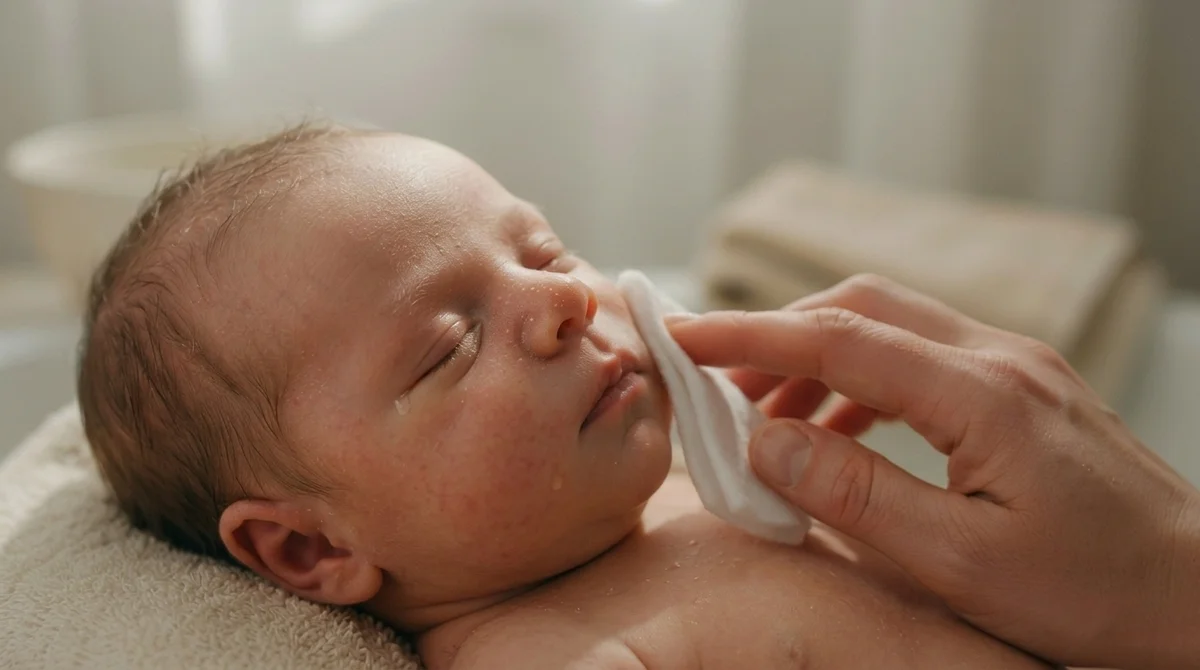
Wipe the face with plain water first, moving from the inner corner of each eye outward — no soap on a newborn's face.
Picture the whole scene: a baby on a thick towel, wrapped loosely, only one patch of skin bare at a time, a parent's hand resting on the chest the entire way through. Calm, warm, unhurried. That is all a good sponge bath actually looks like.
How to Give a Newborn a Tub Bath (Step by Step)
Once the cord stump is gone and the skin underneath is dry, your newborn graduates to a real bath in a small baby tub or a clean sink. It stays short and shallow.
Fill the tub with about two inches of warm water and aim for body temperature — around 100°F (38°C), and never hotter. Test it with your wrist or elbow, not your hand, which is less sensitive to heat. The AAP also recommends setting your water heater no higher than 120°F (49°C), since scald burns are a leading cause of bathroom injuries in young children.
- Fill first, then bring the baby. Never run water with your newborn already in the tub — the temperature can swing hot or cold without warning.
- Lower your baby in feet-first. Support the head and neck along one forearm and hold the far shoulder with that hand. Your other hand does the washing.
- Wash cleanest to dirtiest. Face and head first, then work down the body, with the diaper area last.
- Cup water over the body often. A wet newborn loses heat fast, even in a warm room, so keep them wet rather than exposed.
- For the scalp, go light. A soft washcloth and a pea-sized drop of baby shampoo two or three times a week is all a newborn needs.
- Lift out feet-first with both hands, straight into a hooded towel, and wrap them up before the air hits.

Support the head and neck along one forearm, grip the far shoulder, and lower your baby in feet-first — two inches of warm water is plenty.
How Often Should You Bathe a Newborn?
Three times a week is enough for a newborn's entire first year, according to the American Academy of Pediatrics. Newborns barely sweat and do not get dirty the way older children do, and their skin is thin and quick to dry. Daily bathing — the thing many of us assume is basic hygiene — works against a newborn's skin barrier rather than for it.
So is a bath once a week actually fine? It is. What matters far more than the number is the spot-cleaning in between: the diaper area at every change, the neck and chin creases after spit-up, the hands that always find their way to the mouth. Keep those clean, and three baths a week leaves your baby genuinely clean.
In winter, lean toward fewer baths, not more — dry indoor heat is already hard on newborn skin. Plenty of families settle on a warm evening bath a few nights a week as the anchor of a wind-down routine, which can help cue sleep as your baby gets older. If you are building that rhythm, our guide to baby wake windows by age shows where a bath fits the day.
Oil Massage and the 40-Day Tradition: What's Safe
If your mother or mother-in-law is staying with you, you have probably been handed a completely different rulebook — a warm-oil massage every day, a bath every day, and no stepping outside for forty days. This is where a lot of diaspora parents feel quietly pulled in two directions, agreeing with the pediatrician in the morning and with family by evening.
The forty-day period — chilla in Urdu, jaapa in Punjabi, sawa mahina across much of South Asia, al-nifas in Arabic-speaking homes — is a postpartum confinement tradition built around rest and recovery for the mother. It was never a medical schedule for the baby's baths. There is no rule that a newborn must stay unwashed for forty days, and no need to scrub them head to toe every single day either.
The daily oil massage, though, is worth keeping. Gentle infant massage — maalish — supports bonding, and many parents find it settles a baby before sleep. A few small adjustments keep it in step with pediatric advice: massage before the bath rather than instead of it, use only a little oil, and patch-test a new oil on one small spot first. Be careful with mustard oil on broken or irritated skin, and if your baby shows signs of eczema, go gentler still — our baby eczema treatment guide explains which oils and routines help and which make it worse.

A gentle warm-oil massage (maalish) before the bath — soothing for the baby, and a tradition worth keeping with a few safe tweaks.
These two frameworks are not really at war. The tradition's wisdom — rest, warmth, family hands, nourishing food — lines up with what doctors want for a recovering mother. The pediatric additions are narrow: do not over-bathe, keep the water warm rather than hot, and protect the cord. You can honor your grandmother and your pediatrician in the same week without picking a side.
Bath Safety Rules That Actually Matter
This is the section to read twice. Drowning is the one bath risk that offers no second chance, and it does not need a full tub to happen. A baby can drown in one to two inches of water, in the few seconds it takes to reach for a forgotten towel. The AAP notes that most in-home drownings of young children happen in the bathtub, and more than half involve babies under a year old.
Keep at least one hand on your baby for the entire bath. The AAP calls this touch supervision, and it is the single habit that prevents nearly every bathtub tragedy. If the doorbell rings or the phone buzzes, the baby comes with you, wrapped in a towel. There is no exception worth making.
- Fill the tub before your baby goes in, and drain it the second the bath is done.
- Keep the water to about two inches for a newborn — deeper is not cleaner or safer.
- Set your water heater to 120°F (49°C) or below to prevent scald burns.
- Lay a non-slip mat under the basin or tub so nothing slides.
- Gather every supply before you start, so you never have to walk away mid-bath.
Soap, Skin, and What to Do After the Bath
Less is genuinely more with newborn skin. For most baths, warm water alone gets a baby clean. When you do reach for soap, the American Academy of Dermatology recommends a mild, fragrance-free baby wash used sparingly — mostly on the diaper area and any spot that is actually dirty, not a full lather head to toe.
If your baby's skin looks dry or flaky afterward, the AAD's fix is simple: a fragrance-free moisturizer, or just bathing less often. The most effective moment to apply it is the first few minutes out of the water, while the skin is still slightly damp — this soak-and-seal timing traps moisture where it counts.
Those greasy yellow scales that show up on the scalp are cradle cap, not a sign you washed wrong. A soft brush or washcloth during the bath, plus a little patience, usually handles it. Our guide to cradle cap covers what helps and what to leave alone.
When Your Newborn Hates the Bath
Plenty of newborns scream through the entire bath, and it can feel like you are doing something cruel to them. You almost certainly are not. Most bath-haters are reacting to one of three things: cold air on bare skin, the startle of being undressed, or the simple loss of being held tightly.
Warming the room first helps more than anything else. So does laying a warm, wet washcloth over your baby's chest while you wash, keeping a firm hand on them throughout, and keeping the whole thing under five minutes. If the crying does not stop when the bath does — if it stretches on through the evening — that is a different problem, and our guide on why a newborn won't stop crying works through the usual causes.
If you hold onto only two rules, make them these: sponge baths until the cord stump drops off, and one hand on your baby for every second in the water. The rest — the oil massage, the bedtime bath, the lighter winter schedule — is yours to shape around your own family and your baby's skin. And the shaking hands? They fade fast. By the fourth or fifth bath, you will be the calm one, telling some newer parent that it is far easier than it looks.
Sources
- American Academy of Pediatrics (HealthyChildren.org) — Bathing Your Newborn
- World Health Organization — Recommendations on Newborn Health
- Cleveland Clinic — Delaying a Newborn's First Bath Increases Breastfeeding Success
- American Academy of Dermatology — How to Bathe Your Newborn
- Journal of Global Health (2022) — Timing of First Bath in Term Healthy Newborns: A Systematic Review
This article is for general information and does not replace medical advice. Always follow the guidance of your pediatrician, and reach out to them with any concerns about your newborn's umbilical cord, skin, or bathing — especially if your baby was born prematurely or has a health condition.
From ovulation tracking and due dates to baby names and growth charts. Everything you need for your journey.
Share this post
Frequently Asked Questions
Related Topics
Contents
About the Author
Browse our curated baby name collection
Get the latest parenting tips and updates delivered to your inbox.
Read Next

Combo Feeding Your Newborn: How to Mix Breast Milk and Formula Safely
How to combo feed your newborn safely — with sample schedules by age, milk supply protection tips, mixing guidance, and honest answers to every question new parents ask.
Read Article
Diaper Rash Won't Go Away? How to Tell What's Wrong
If diaper rash won't go away after cream, the cause may be yeast, bacteria, allergy, moisture, or another skin problem. Learn the signs and when to call.
Read Article
Baby Growth Spurts: Ages, Signs, Feeding Frenzies & When to Worry
Baby feeding nonstop, fussing, or waking more than usual? Learn the common growth spurt ages, signs, duration, and red flags that mean it is time to call the doctor.
Read Article
Baby Reflux: Normal Spit-Up, Silent Reflux Signs, and When to Worry
Baby reflux is common, but GERD needs care. Learn normal spit-up vs reflux, silent reflux signs, safe remedies, sleep rules, and when to call your pediatrician.
Read Article
Cluster Feeding: Why Your Newborn Feeds Nonstop and What to Do About It
Your newborn wants to nurse every 30 minutes and you're running on empty. Here's what cluster feeding actually is, how long it lasts by age, and the real strategies to survive it.
Read Article
Baby Constipation: Signs to Watch, Home Remedies That Work, and When to Call the Doctor
Hard stools, crying during bowel movements, or days without a dirty diaper — here's how to spot real constipation in babies, which home remedies actually help & when it's time for a doctor's call.
Read Article
How to Increase Breast Milk Supply: 11 Things That Actually Work (And 3 That Don't)
Struggling with low milk supply? 11 proven ways to boost breast milk production naturally — plus 3 common myths debunked. Includes a power pumping schedule and signs your supply is actually fine.
Read Article
Newborn Won't Stop Crying? 12 Real Reasons + a Cry Decoder That Works
It's 2 a.m. and the crying won't stop. Decode your baby's cry with our quick-reference table, 12 real causes, and soothing combos that work.
Read Article
Baby Colic: What It Really Is, What Helps and When the Crying Finally Ends
What colic actually looks like, which soothing strategies have evidence behind them, how to tell colic from reflux, and the week-by-week timeline for when the crying stops.
Read Article