
How to Swaddle a Baby, Step by Step — and When to Stop


Your baby sleeps for 40 minutes, startles awake, and screams. You pick them up, settle them, lower them back down — and it happens again. Swaddling is the fix most newborn parents eventually land on, and when it works, it genuinely changes the shape of those first few weeks.
The trouble is that how to swaddle a baby properly involves a few things that aren't obvious from a 2am YouTube video. The wrap needs to be snug enough that it won't come loose — a loose blanket near a baby's face is a suffocation risk — but the bottom half needs to stay open. Your baby's hips need room to move. And the entire practice has an expiration date that catches many parents off guard.
The three rules that matter most
- Snug across the chest. Loose around the hips. Always on their back.
- Stop swaddling at the first sign your baby is trying to roll — usually between 2 and 4 months.
- A swaddled baby who rolls face-down cannot push up to clear their airway. That is the specific danger.
Why Swaddling Works (And What the Startle Reflex Has to Do With It)
Newborns come wired with the Moro reflex — an involuntary startle response that causes their arms to fling outward suddenly, often jerking them fully awake mid-sleep. It is strongest from birth through about 4 months and fades gradually after that. Swaddling holds the arms gently in place, which cuts down the number of times this reflex interrupts a sleep cycle. That is the mechanism. No mystery to it.
There is a separate benefit, too. The snug pressure around the torso recreates the tight quarters of the uterus, which can settle a newborn's nervous system in a way that an open bassinet simply does not. But not every baby responds to this. Some dislike being wrapped from their very first day, and that preference is worth respecting rather than overriding.
How to Swaddle a Baby Step by Step (Blanket Method)
This is the traditional blanket method — the one pediatric guidelines recommend. You need a thin, square cotton or muslin blanket, roughly 44 × 44 inches. Receiving blankets work if they are large enough.
- Lay the blanket in a diamond shape. Fold the top corner down about 6 inches so you have a straight edge at the top.
- Place your baby face-up with their shoulders just below the folded edge. Head above the blanket — never covered.
- Straighten the right arm gently against their side. Pull the left side of the blanket across their chest and tuck it snugly under their right side and back.
- Fold the bottom of the blanket up over their feet, tucking it into the top of the wrap. Leave enough room for their legs to bend up and out — this is the frog-leg position that protects their hips.
- Straighten the left arm. Pull the right side of the blanket across their chest, wrapping it under their body to secure.
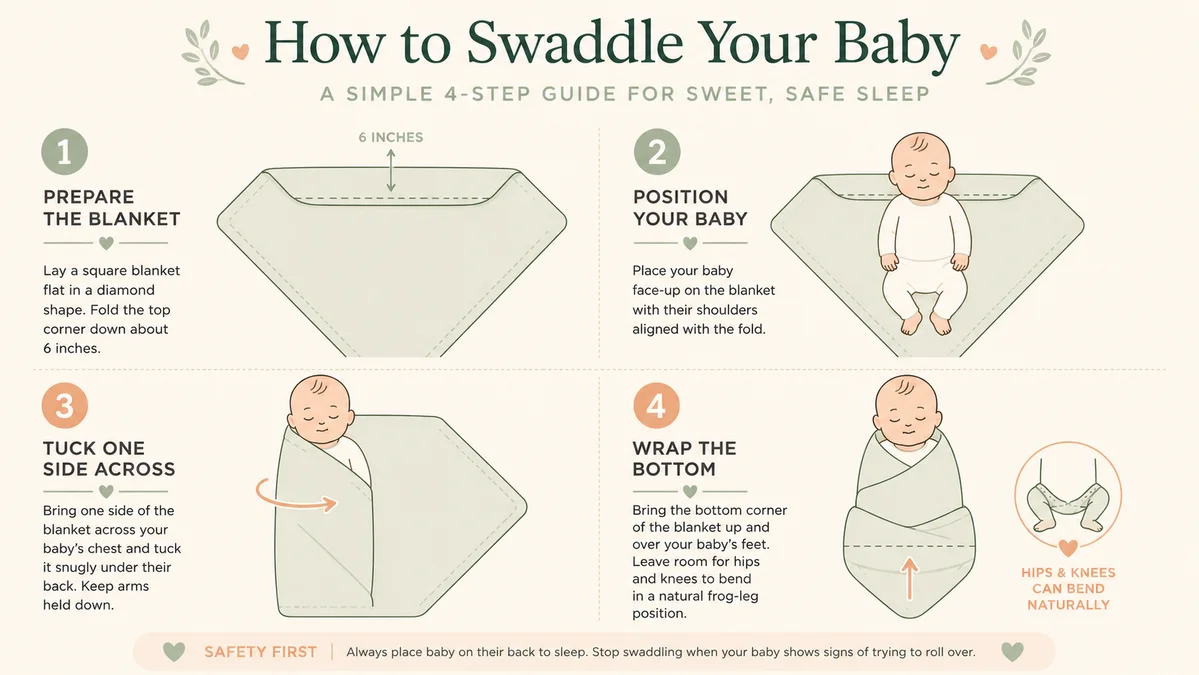
Follow these steps carefully to ensure the swaddle is secure on top but loose around the hips.
The two-finger check: slide two to three fingers between the blanket and your baby's chest. If you can't fit them, loosen the top — the chest needs room for breathing. If the wrap shifts easily when your baby moves, it is too loose and could come undone during sleep.
The Hip-Safe Swaddle Rule Most Guides Skip
The International Hip Dysplasia Institute is specific on this point: the swaddle should be snug around the upper body but loose around the hips and legs. A baby's hips need to sit in a natural bent, open position — what pediatric orthopedists call flexion and abduction, and what parents usually recognize as the frog-leg or M-shape.
When the legs are wrapped straight and pressed together for long stretches, it puts stress on the hip socket. That stress can contribute to developmental dysplasia of the hip (DDH) — a condition where the socket does not form properly around the ball of the thighbone. Risk is higher in babies who are already predisposed: breech presentation, family history, or firstborns.
This matters especially in families where the traditional method involves wrapping the entire body tightly, legs included. That practice is common across South Asian, Middle Eastern, and Central Asian cultures, and in many of those families, swaddling technique is passed from grandmother to mother directly. The instinct behind it — comfort, warmth, security — is exactly right. The adjustment is small but specific: keep the top snug, but let the bottom stay loose enough that your baby's knees can bend and their hips can spread. You can honor the tradition and protect the hips at the same time.
Is Swaddling Safe?
Swaddling is safe for newborns when three conditions hold: the baby is placed on their back to sleep, the wrap is snug on top but allows hip movement, and the baby has not started attempting to roll. The American Academy of Pediatrics supports swaddling as a calming technique under those conditions.
The risk enters when a swaddled baby ends up face-down. A 2016 meta-analysis in Pediatrics (Pease et al.) analyzed four studies and found that swaddled infants placed prone had a significantly elevated SIDS risk. Swaddled infants placed on their backs did not show the same increase. The research distinction matters: swaddling is not the hazard. Swaddling combined with stomach sleeping — or the ability to roll — is the hazard.
Overheating is the other concern worth watching. Stick with a lightweight cotton or muslin blanket, not fleece. Dress the baby in a single layer underneath — usually a onesie. If the back of their neck feels hot or damp, they are overdressed. Room temperature around 68–72°F (20–22°C) is the target range endorsed by CDC safe sleep guidance.
When to Stop Swaddling
Stop swaddling at the first sign your baby is attempting to roll over. The AAP does not set a specific age cutoff — the trigger is the rolling milestone, not a number on the calendar. Most babies begin showing early rolling signs between 2 and 4 months, though some start as early as 8 weeks.
What rolling signs actually look like:
- Twisting at the hips during sleep or tummy time
- Rolling onto their side from back or tummy
- Arching the back strongly and pushing off surfaces
- Repeatedly breaking arms out of the swaddle at night
- Lifting legs high and throwing them to one side
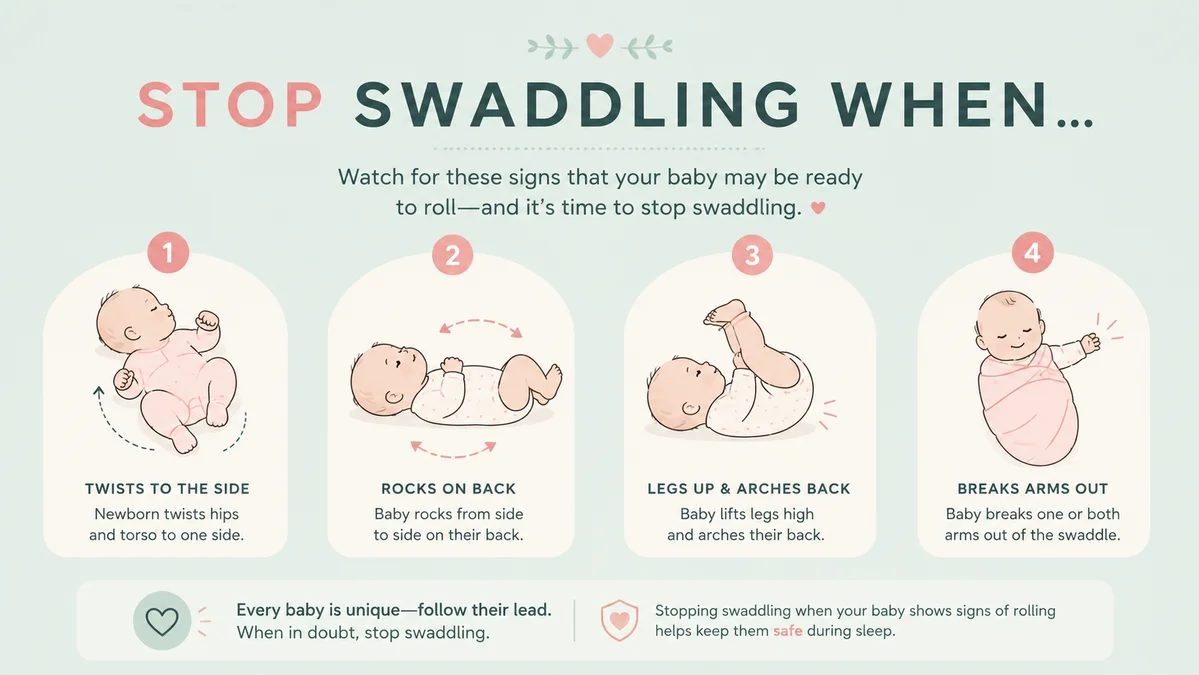
Safety first: Discontinue swaddling immediately at the first sign of rolling attempts.
Do not wait until the baby has completed a full roll. A swaddled baby who rolls onto their stomach cannot use their arms to push up, lift their head, or move their face off the mattress. The danger is in the attempt, not just the accomplishment. If your 8-week-old is showing these signs, stop then. HealthyChildren.org states this directly: age does not override the developmental signal.
How to Transition Out of the Swaddle
Two approaches work. Cold turkey — you stop swaddling entirely and switch to a wearable sleep sack in one night. Or gradual — you leave one arm out for a few nights, then both arms, then move to a sleep sack. Cold turkey tends to work best for babies who are already busting free on their own. Gradual suits babies who still rely heavily on the wrap for settling.
Expect 2 to 3 rough nights either way. The startle reflex may still be somewhat active, and the swaddle transition often overlaps with the 4-month sleep regression, which makes everything feel harder than it actually is. A wearable sleep sack gives the familiar cozy feeling without restricting arm movement — that is the natural next step for most families. If timing feels off and your baby seems overtired or undertired during this phase, checking their age-appropriate wake windows can help.
When the Swaddle Isn't Working
Some babies fight the swaddle from the start. That is not a technique failure — it is a preference. Try swaddling when the baby is calm and drowsy, not already crying. If they consistently break free, arch away, or seem more agitated wrapped than unwrapped, they are communicating something useful. Arms-up swaddle designs exist for babies who want their hands near their face. Sleep sacks without arm restriction work from day one.
Swaddling is a tool, not a requirement. The AAP does not say every baby needs to be swaddled. It says swaddling is safe when done correctly. If the real issue is that your baby only sleeps when held and rejects the bassinet entirely, that is a different problem — and our safe sleep guide covers the rules that still apply on hard nights.
Sources
- American Academy of Pediatrics (HealthyChildren.org) — Swaddling: Is It Safe?
- International Hip Dysplasia Institute — Hip-Healthy Swaddling
- Mayo Clinic — How to Swaddle a Baby
- Pease et al. (2016) — Swaddling and the Risk of SIDS: A Meta-Analysis, Pediatrics
- CDC — About SIDS and Safe Infant Sleep
This article is for informational purposes and does not replace medical advice. Talk to your pediatrician about swaddling, safe sleep, hip concerns, or any questions about your baby's development.
From ovulation tracking and due dates to baby names and growth charts. Everything you need for your journey.
Share this post
Frequently Asked Questions
Related Topics
Contents
About the Author
Browse our curated baby name collection
Get the latest parenting tips and updates delivered to your inbox.
Read Next

Safe Sleep for Babies — What the AAP Actually Recommends (and Why)
The AAP's safe sleep rules explained simply — crib setup, SIDS prevention, what's actually safe and what's not, and what to do when your baby (or your family) doesn't follow the guidelines.
Read Article
Toddler Sleep Regression at 18 Months and 2 Years: What’s Real and What Helps
Your toddler was sleeping through the night — now they’re not. What’s behind the 18-month and 2-year sleep regressions, how long they last, and the strategies that actually work.
Read Article
Baby Wake Windows by Age: The Complete Sleep Schedule Guide (0–12 Months)
Struggling with baby sleep? Learn how to calculate wake windows by age, spot sleepy cues before meltdowns, and structure your baby's sleep schedule.
Read Article
Gagging vs. Choking: What Every Parent Starting Solids Needs to Know
That retching sound is terrifying — but is it gagging or choking? Learn the difference instantly, step-by-step infant first aid, safe food shapes, and how to manage mealtime anxiety.
Read Article
Newborn Won't Stop Crying? 12 Real Reasons + a Cry Decoder That Works
It's 2 a.m. and the crying won't stop. Decode your baby's cry with our quick-reference table, 12 real causes, and soothing combos that work.
Read Article
Baby-Led Weaning First Foods — What to Serve, How to Start, and What to Skip
Your no-stress guide to baby-led weaning first foods at 6 months. Best starter foods by category, a simple first-week plan, gagging vs choking explained, and foods to skip.
Read Article