
Exclusive Pumping: Schedules, Supply Tips & What No One Tells You

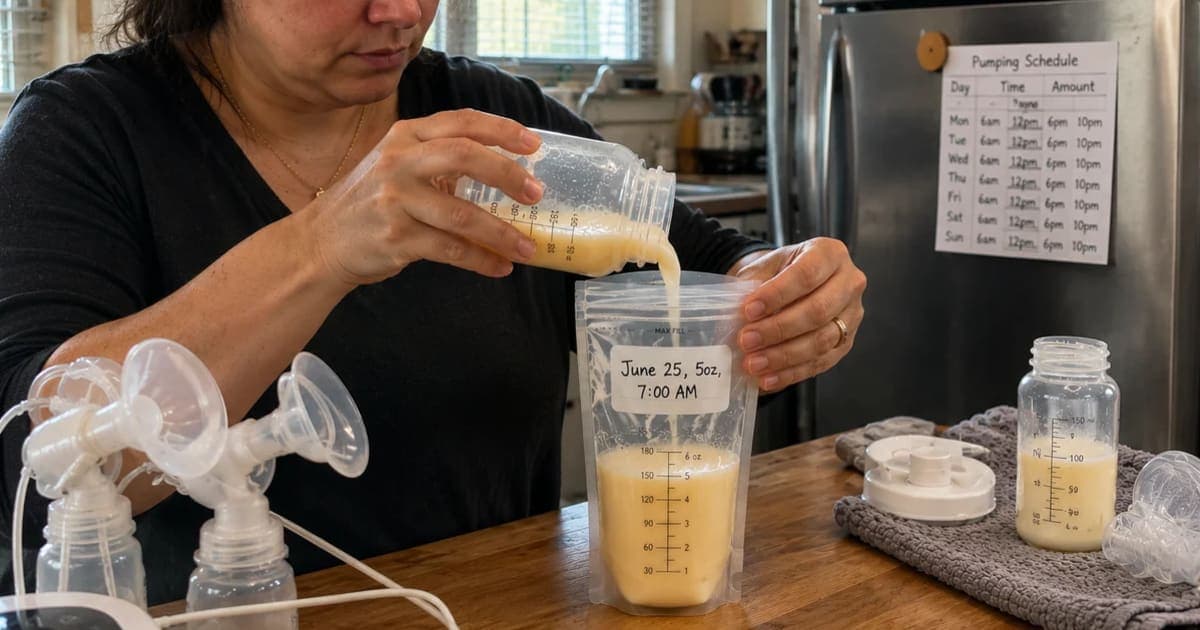
You are pumping every three hours, washing flanges at 2 a.m., and wondering whether any of this is actually working. Nobody in your birth prep class talked about exclusive pumping — because the assumption was always that breastfeeding meant a baby at the breast. It does not. Exclusive pumping means your baby gets breast milk for every feeding, but that milk arrives through a pump and a bottle instead of a latch. It is real breastfeeding. It is also one of the most physically and emotionally demanding ways to feed a baby, and it deserves its own guide — not a sidebar paragraph in a nursing article. This one covers exactly what you need: pumping schedules by age, evidence-based supply strategies, equipment that actually matters, and the emotional side that every other guide skips.
What Exclusive Pumping Actually Means — and Why It Deserves Its Own Guide
Exclusive pumping — sometimes called EPing — means feeding your baby expressed breast milk for all or nearly all feedings, without direct nursing at the breast. It is not a fallback plan. It is a deliberate, valid feeding method chosen by parents whose circumstances make direct nursing impractical, painful, or impossible.
Why do parents choose it? The reasons span a wide range. A baby born with a tongue-tie or cleft palate who cannot latch effectively. A premature infant in the NICU who is not yet able to nurse. A mother with flat or inverted nipples, D-MER (dysphoric milk ejection reflex), or sensory aversion that makes direct nursing deeply uncomfortable. A return to work at six weeks with minimal pumping accommodation. And sometimes, simply a personal preference that does not require justification. Whatever the reason, the AAP's 2022 policy statement makes no clinical distinction between breast milk delivered at the breast and breast milk delivered in a bottle. The immunological and nutritional profile is the same.
If you are already dealing with the logistical reality of breast and bottle, our combo feeding guide covers the formula-and-breast-milk side. This guide is for those going all-in on pumped milk.
Exclusive Pumping Schedules — Newborn Through 12 Months
The single most common question from EP moms is: how often do I pump, and when can I drop a session? Here is a month-by-month framework based on lactation consultant guidance and the CDC's recommendations for pumping frequency. These are starting points — your body and your baby's needs will fine-tune them.
| Baby's Age | Sessions / 24 hrs | Interval | Duration | Key Notes |
|---|---|---|---|---|
| 0–4 weeks | 8–12 | Every 2–3 hrs | 15–20 min | Include at least 1 overnight session between 2–5 AM (peak prolactin window) |
| 1–3 months | 7–9 | Every 2.5–3.5 hrs | 15–20 min | Supply typically regulates around week 12; adjust only after confirmed stable output |
| 3–6 months | 5–7 | Every 3–4 hrs | 15–20 min | Many moms safely drop the overnight pump here if 24-hr output remains steady |
| 6–9 months | 4–6 | Every 4–5 hrs | 15–20 min | Baby starting solids; milk demand shifts gradually |
| 9–12 months | 3–5 | Every 4–6 hrs | 15 min | Compatible with gradual weaning if desired |
Two things this table cannot capture: your individual storage capacity (some breasts hold more milk and tolerate longer gaps) and your baby's specific intake needs. If your output stays steady after spacing sessions out, your body is adapting. If it dips, add one session back for a few days before trying again. If your baby is experiencing cluster feeding phases, temporarily increasing sessions can help match their demand.
The 3-3-3 Rule for Pumping — Two Different Meanings
If you have searched for pumping rules, you have probably encountered the “3-3-3 rule” and found conflicting information. That is because it refers to two completely different things depending on the context.
As a storage guideline: breast milk is safe for 3 hours at room temperature, 3 days in the refrigerator, and 3 months in a standard freezer. This is a conservative mnemonic. The CDC's current guidelines actually allow slightly longer windows — 4 hours at room temperature, 4 days refrigerated, 6 to 12 months frozen — but the 3-3-3 version is cautious and easy to remember, especially at 3 a.m.
As a supply-building protocol: pump every 3 hours, for 3 consecutive days, continuing 3 minutes past your last drop of milk each session. This sends a concentrated demand signal to your body and is often recommended by lactation consultants during a temporary supply dip caused by stress, illness, or missed sessions.
Your First Week — Starting Exclusive Pumping From Day One
If you know before delivery that you will exclusively pump, tell your nursing staff and request a hospital-grade pump immediately. In the first 24 to 48 hours, hand expression often works better than a pump — colostrum is thick, comes in tiny amounts, and coats the inside of pump parts where it gets wasted. Express into a syringe or small cup and feed it to your baby directly.
By day two or three, start double pumping every two to three hours, including overnight. You will not get much. That is normal. Your milk transitions from colostrum to transitional milk around days three to five, and volume increases dramatically during this shift. The purpose of early pumping is not output — it is stimulation. Every session tells your body: this baby needs milk. The more signals you send in the first 72 hours, the stronger the supply foundation you build.
Protecting Your Milk Supply Without a Baby at the Breast
This is the core challenge of exclusive pumping. A nursing baby creates a biological feedback loop: their saliva on the nipple signals the breast to adjust immune composition, their suckling pattern triggers hormonal release, and their cluster feeding drives supply spikes. A pump does none of this. You have to create the demand manually. Here is what actually works, ranked by evidence.
- Empty completely every session. Residual milk in the breast signals your body to slow production. After your let-down tapers off, use breast compression and hand expression for two to three additional minutes. Research from Stanford Medicine found that hands-on pumping increased milk output by 48% compared to pump suction alone.
- Power pump once daily during a dip. Twenty minutes on, ten off, ten on, ten off, ten on. This mimics cluster feeding and sends a concentrated demand signal. It is not a daily requirement forever — use it as a tool when output drops, usually for three to five days.
- Get your flange size right. The default flanges that ship with most pumps fit a narrow range of nipple diameters. If your nipple rubs against the tunnel walls, swells to fill the tunnel, or barely enters it, the fit is wrong. Measure your nipple diameter at the base (not the areola) and add 2 to 3 millimeters. Most pump brands offer flanges from 15mm to 30mm. This single adjustment fixes more “low supply” problems than any supplement.
- Protect the early morning session. Prolactin — the hormone that drives milk production — peaks between 2 and 5 a.m. Dropping the overnight pump is tempting, but doing it before your supply is established (typically before 12 weeks) can permanently reduce your baseline output.
- Hydrate and eat enough. This is not about galactagogues or lactation cookies. It is about basic caloric intake. Producing breast milk burns roughly 500 calories per day. If you are skipping meals because you are too busy pumping and caring for a newborn, your supply will reflect it.
For a deeper breakdown of supply strategies — including what the evidence says about oatmeal, fenugreek, and power pumping protocols — see Nurturepedia's complete guide to increasing breast milk supply.
Equipment That Matters — and What You Can Skip
The pumping gear market is overwhelming. Here is what exclusive pumpers actually need, what helps, and what is marketing noise.
A quality double electric pump is non-negotiable. Hospital-grade pumps (Medela Symphony, Spectra S1/S2) have the motor strength to sustain 8 to 12 daily sessions without losing suction over time. If insurance covers a pump — and in the U.S., the ACA requires most plans to cover one — choose the best double electric option available. Wearable pumps (Elvie, Willow, Momcozy) are convenient for mobility but generally produce lower output per session. They work well as a secondary pump, not a primary one for establishing supply.
Correctly sized flanges are more important than the pump itself. We covered sizing above. If you bought a pump and the default flanges hurt or produce less than expected, try a different size before assuming you have a supply problem.
A hands-free pumping bra turns every session from a two-handed immobilization into something you can do while eating, working, or scrolling your phone at 4 a.m. This is not a luxury — when you pump eight or more times a day, freeing your hands is a mental health decision.
Spare parts. Duckbill valves, membranes, and backflow protectors wear out. When they do, suction drops and output drops with it. Replace duckbill valves every four to eight weeks. Keep at least one full spare parts kit assembled and ready.
What you can skip: lactation supplement bundles, specialty pumping sprays (coconut oil works), elaborate sterilization systems (hot soapy water and a daily steam bag are sufficient per CDC cleaning guidelines), and any product that promises to “double your supply.”
The Part Nobody Talks About — Your Mental Health as an EP Mom
Here is the math no one shows you. Eight pumping sessions per day, each lasting 20 minutes of actual pumping plus 10 minutes of assembly, cleanup, and milk storage. That is four hours a day tethered to a machine — on top of feeding the baby, changing the baby, holding the baby, and trying to sleep. You are doing the work of breastfeeding and the work of bottle-feeding simultaneously, with the support infrastructure of neither.
Exclusive pumping is isolating in a specific way. You do not belong in nursing support groups because you are not latching a baby. You do not belong in formula feeding circles because you are not using formula. You exist in a space between the two, and most healthcare providers — including lactation consultants — are not trained to support it. Feeling invisible in this process is not a character flaw. It is a systemic gap.
If resentment toward the pump is growing, if you dread sessions instead of simply finding them tedious, or if the schedule is making postpartum depression symptoms worse, those are signals worth listening to. Exclusive pumping is not a moral obligation. It is a feeding method. Switching to formula, reducing sessions, or stopping entirely does not erase the breast milk your baby has already received. If you are navigating mood changes alongside the pumping grind, our guide on postpartum depression versus baby blues can help you sort what is normal exhaustion from what needs clinical attention.
When Your Family Says You Are Not “Really” Breastfeeding
In many South Asian, Arab, and immigrant families, breastfeeding carries deep cultural weight — but the word is understood exclusively as nursing at the breast. A mother who pumps and bottle-feeds breast milk often faces a specific kind of scrutiny that Western parenting content never addresses: the mother-in-law who asks “why are you not putting the baby to the breast,” the family gathering where stepping away to pump is met with confusion instead of support, the quiet implication that what you are doing is somehow less natural or less devoted.
The medical answer is unambiguous. The AAP classifies all human milk feeding — whether delivered at the breast, through a bottle, through a cup, or through a syringe — as breastfeeding. Expressed milk provides the same antibodies, the same nutrients, and the same immunological protection. If you need language for that conversation: “My baby is getting breast milk at every feed. The AAP considers this breastfeeding. My pediatrician supports it.” You should not have to defend a feeding method to anyone who is not your child's doctor. But if having the clinical backing makes the conversation easier, you have it.
When and How to Wean From Exclusive Pumping
Weaning from exclusive pumping requires a gradual approach to avoid engorgement, clogged ducts, and mastitis. The process typically takes two to four weeks.
- Drop one session every three to five days. Start with the session that produces the least milk — usually a mid-day pump. Keep the early morning session (highest output) and any session your body seems to rely on most.
- Shorten before you drop. If dropping a full session causes discomfort, reduce its duration by five minutes instead. Let your body adjust for two to three days, then reduce again until you are pumping just long enough for comfort relief.
- Watch for clogs. Sunflower lecithin (one to two capsules daily) is commonly recommended by lactation consultants during weaning to reduce clog risk, though the evidence is largely anecdotal. Warm compresses before pumping and cold compresses after can help.
- Expect hormonal shifts. Weaning is a hormonal event, not just a logistical one. Dropping prolactin levels can trigger mood changes, irritability, or sadness — even if you are ready to stop. These usually resolve within a week or two of completing the weaning process.
There is no universally correct time to wean. Some mothers pump for three months, some for over a year. The AAP recommends breast milk feeding for two years or longer, but that is a population-level guideline — not a personal mandate. You are allowed to stop when the cost to your wellbeing outweighs the benefit, and that calculation is yours alone to make.
Sources
- American Academy of Pediatrics — Breastfeeding and the Use of Human Milk (2022 Policy Statement)
- CDC — Pumping Breast Milk
- CDC — Proper Storage and Preparation of Breast Milk
- Stanford Medicine — Maximizing Milk Production (Hands-On Pumping)
- La Leche League International — Pumping Milk
- CDC — How to Keep Your Breast Pump Kit Clean
This article is for informational purposes and does not replace medical advice. If you have concerns about your milk supply, your baby's growth, or your own wellbeing, consult your pediatrician or a board-certified lactation consultant (IBCLC).
From ovulation tracking and due dates to baby names and growth charts. Everything you need for your journey.
Share this post
Frequently Asked Questions
Contents
About the Author
Browse our curated baby name collection
Get the latest parenting tips and updates delivered to your inbox.
Read Next

Combo Feeding Your Newborn: How to Mix Breast Milk and Formula Safely
How to combo feed your newborn safely — with sample schedules by age, milk supply protection tips, mixing guidance, and honest answers to every question new parents ask.
Read Article
Baby Growth Spurts: Ages, Signs, Feeding Frenzies & When to Worry
Baby feeding nonstop, fussing, or waking more than usual? Learn the common growth spurt ages, signs, duration, and red flags that mean it is time to call the doctor.
Read Article
Breastfeeding Positions: 7 Holds for a Pain-Free, Deep Latch
Struggling with a painful latch? Discover 7 safe breastfeeding positions (like side-lying and football holds) that make nursing comfortable. Backed by lactation experts.
Read Article
Cluster Feeding: Why Your Newborn Feeds Nonstop and What to Do About It
Your newborn wants to nurse every 30 minutes and you're running on empty. Here's what cluster feeding actually is, how long it lasts by age, and the real strategies to survive it.
Read Article
How to Increase Breast Milk Supply: 11 Things That Actually Work (And 3 That Don't)
Struggling with low milk supply? 11 proven ways to boost breast milk production naturally — plus 3 common myths debunked. Includes a power pumping schedule and signs your supply is actually fine.
Read Article
How to Introduce Peanut Butter to Your Baby — Exact Amounts, Prep, and Safety
How to introduce peanut butter to your baby safely — with exact measurements, step-by-step prep, allergy signs by severity, and risk-based timing from the NIAID guidelines.
Read Article