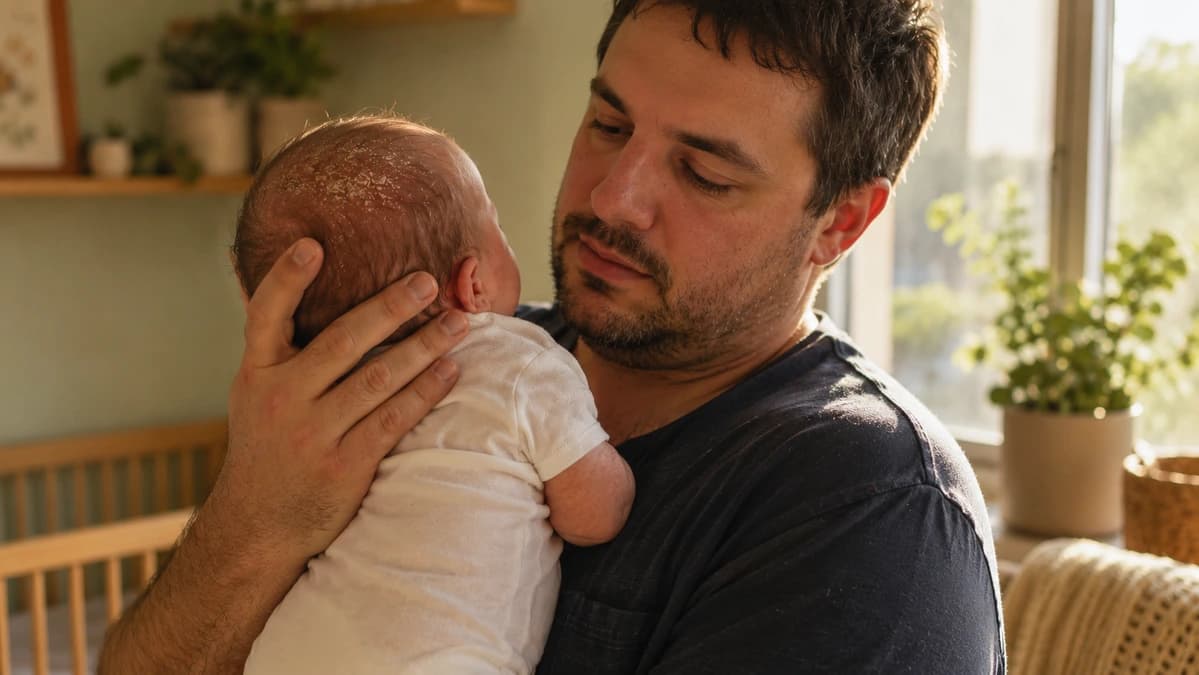
Your baby's cord stump looks strange, smells a little off, and you are not sure if you are supposed to clean it, leave it alone, or worry about it. Every new parent has this moment. The good news: umbilical cord care for a newborn is simpler than it looks — and the single most important instruction has changed since your own parents were told what to do.
The old advice was to swab the stump with rubbing alcohol at every diaper change. That is no longer the recommendation. The American Academy of Pediatrics now recommends dry cord care — keeping the stump clean and dry, with no alcohol, no ointments, and no powders applied to it. Research found that alcohol actually slowed cord separation without reducing infection rates in countries with clean birth conditions. Dry care lets the stump dry and fall off faster.
Key Takeaways
- Keep it dry. No alcohol, no powders, no ointments — just air.
- Fold the diaper down below the stump so it stays exposed and urine-free.
- Sponge baths only until the stump has separated and the belly button looks dry.
- Never pull the stump — even if it looks like it is hanging by a thread.
How to Care for Your Newborn's Umbilical Cord Stump
The cord stump is a small piece of tissue left after the umbilical cord is clamped and cut at birth. It has no nerve endings — your baby cannot feel it. Cleaning around it, folding the diaper beneath it, changing clothes over it — none of that causes pain. The stump is not a wound in the way a cut is. It is dead tissue drying out, and the body will shed it on its own schedule.
Day-to-day care is minimal. If the stump gets soiled during a diaper change — urine or stool on or near the base — clean it gently with a damp cotton swab or washcloth and plain water. Pat it dry. That is the full cleaning protocol. You do not need to clean it routinely if it is not dirty. The less you handle it, the faster it dries. For more on the diaper fold technique that keeps the stump clear, our newborn diapering guide covers the details.
Stick with sponge baths during this period. Submerging the stump in bathwater keeps it moist and slows the drying process. Once the stump falls off and the skin underneath looks dry and healed — usually a couple of days after separation — you can switch to tub baths. Our newborn bathing guide walks through that transition step by step.
What About the Smell?
Parents notice this and panic. A mild musty or slightly sour smell from the drying stump is normal — it is tissue losing moisture, not rotting. Think of it the same way you would a scab: not pleasant, but not alarming. The smell that signals trouble is different. A genuinely foul odor, especially paired with yellowish-green discharge or pus at the base, points toward infection and needs a call to your pediatrician the same day.
When Does the Cord Fall Off?
The umbilical cord stump typically falls off between 7 and 21 days after birth, with most separating around the 10- to 14-day mark. The stump dries, shrinks, changes color from yellowish to brown or black, and eventually detaches on its own. The Mayo Clinic confirms this 1-to-3-week window and notes that keeping the area dry is the single most effective way to support timely separation.
A few things can slow the process. Moisture — from bathwater, covered diapers, or applied substances — keeps the tissue soft instead of letting it dry. Thick clothing layered over the stump traps humidity. Some babies just take longer, and a stump that is still attached at day 18 with no redness, swelling, or smell is not automatically a problem. Mention it at your next well-visit. If it is still attached after three to four weeks, your pediatrician will want to investigate less common causes of delayed separation.
Umbilical Cord Stump Healing Stages
Nobody prepares you for how the stump actually looks at each stage. Here is what to expect — because "it changes color" is not specific enough when you are staring at it under a bathroom light at midnight.
| Stage | Timing | What It Looks Like |
|---|---|---|
| Fresh | Day 1–3 | Yellowish-green, moist, soft, with a plastic clamp still attached |
| Drying | Day 3–7 | Darker, firmer, starting to shrink — clamp may be removed at a visit |
| Shriveled | Day 7–14 | Brown to black, thin and hard, pulling slightly from the base |
| Separating | Day 10–21 | Hanging loosely, a small spot of blood or clear discharge at the base is normal |
| Healed | 2–5 days after separation | A small, dry indentation — your baby's belly button |
A small amount of clear or slightly yellowish discharge around the base during the separating stage is normal. So is a tiny spot of blood on the diaper — think pinpoint, not pooling. The stump sometimes falls off in one piece; other times a small remnant stays attached for another day or two. Both patterns are fine.
Infection Red Flags — Normal vs. Infected Umbilical Cord
Umbilical cord infection — clinically called omphalitis — is rare in developed countries, occurring in roughly 0.2 to 0.7 percent of newborns according to the NIH's StatPearls clinical reference. Rare does not mean unimportant. Omphalitis can progress to sepsis quickly in a newborn, which is why the warning signs matter more than the statistics.
- Redness spreading beyond the base of the stump onto the surrounding skin
- Swelling or hardness in the skin around the belly button
- Pus or foul-smelling discharge — yellow, green, or white
- Fever of 100.4°F (38°C) or higher in a newborn under 3 months
- Bleeding that does not stop after 10 minutes of gentle pressure
- Your baby cries when you touch the skin around the stump — not the stump itself
- Feeding changes — refusing to eat, unusual sleepiness, or general irritability
The distinction between normal and infected is usually clear once you know what to look for. A normal stump has dry tissue changing color with minimal discharge. An infected stump has wet, spreading redness on the living skin around it. If you are not sure — and at 2 a.m. with a four-day-old baby, "not sure" is a completely reasonable state — call your pediatrician. They would rather hear from you at an early stage than a late one. If your baby also has a fever, our guide to newborn fever covers when that becomes an emergency.
Umbilical Granuloma — What That Pink Bump Means
After the stump falls off, some babies develop a small, moist, pinkish-red bump where the cord was attached. This is an umbilical granuloma — a common overgrowth of tissue during healing that is not an infection and not dangerous. It has no nerve endings, so it does not hurt your baby. Cleveland Clinic describes it as one of the most frequent post-cord complications, and treatment is straightforward: a pediatrician applies a small amount of silver nitrate to the tissue, which causes it to dry up and fall off, usually after two or three applications. Some granulomas resolve on their own without treatment. Either way, it is a minor issue with a quick fix — not a reason to worry.
After the Stump Falls Off
The belly button underneath will look raw for a day or two. You may see a small amount of clear or pinkish discharge, which is normal healing. Gently clean the area with a damp cotton swab during regular baths and pat it dry. Within a few days, the skin closes and dries completely — and you have a belly button.
This is when tub baths become an option. Wait until the belly button area looks fully dry and has no open or weeping spots. For most babies, that is two to four days after the stump separates. There is no rush — sponge baths work just fine a little longer.
A Note on Traditional Cord Care Practices
In many South Asian, Middle Eastern, and African families, grandmothers apply turmeric, ghee, mustard oil, breast milk, or ash to the cord stump. The intention is protection, and these practices come from generations of care, not carelessness. But the medical evidence is consistent: the World Health Organization recommends keeping the cord dry and free of applied substances in settings where births happen in clean conditions. Applying anything to the open stump — even substances with cultural healing associations — creates a moist environment that bacteria can use as an entry point. You do not need to argue with your mother-in-law about the medical literature. You can simply say the hospital told you to keep it dry, and that is what you are doing.
Sources
- American Academy of Pediatrics (HealthyChildren.org) — Umbilical Cord Care
- Mayo Clinic — Umbilical Cord Care: Do's and Don'ts for Parents
- Cleveland Clinic — Umbilical Granuloma
- National Library of Medicine — Omphalitis (StatPearls Clinical Reference)
- World Health Organization — Postnatal Care of the Mother and Newborn (Cord Care Guidance)
This article is for informational purposes and does not replace medical advice. Contact your pediatrician about any cord stump concern — redness, swelling, discharge, delayed separation, or anything that does not look right to you. A parent's instinct that something is off is always worth a phone call.
The cord stump phase is short. It feels long because every diaper change involves working around this strange little appendage and wondering if you are going to break something. You are not going to break anything. Keep it dry, fold the diaper down, wash your hands before you handle it, and leave the rest to biology. One morning the stump will be gone, the belly button will be there, and you will have one fewer thing to worry about — for approximately twelve minutes, until the next thing arrives.