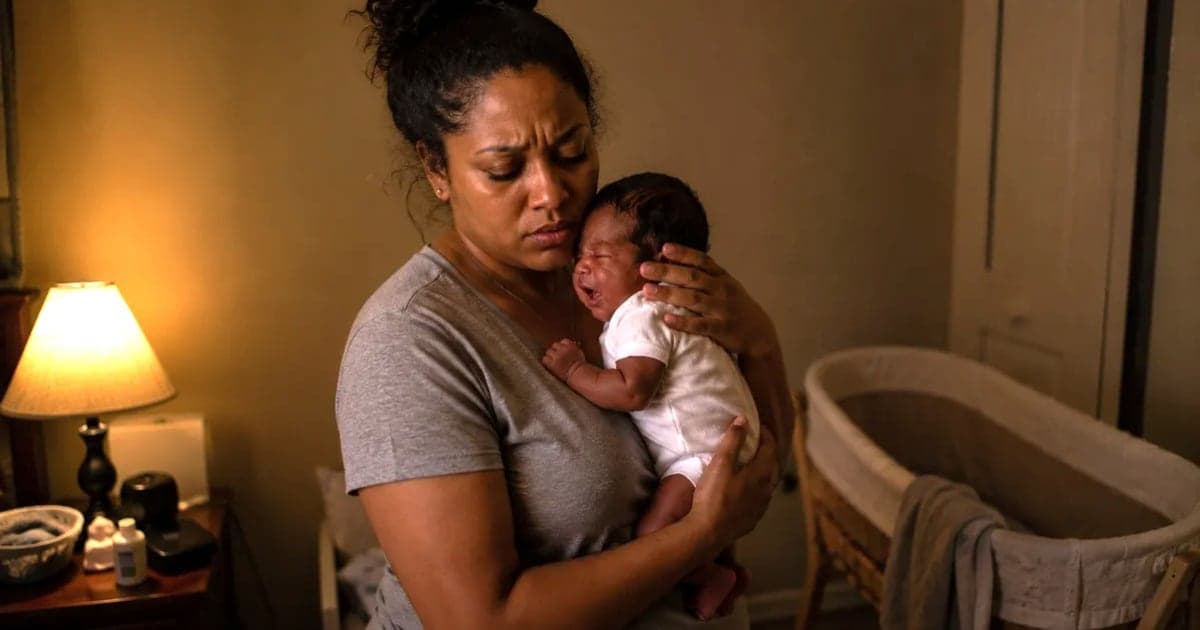
The call comes on day four: your baby's newborn screen shows G6PD deficiency. Or you're beside a phototherapy cot when a doctor mentions they've "sent off a G6PD." G6PD deficiency in newborns is common, inherited and very manageable. What it changes is how closely jaundice needs watching in the first two weeks, and what stays out of your baby's world for good.
Nothing you did in pregnancy caused it; it's written into a gene your baby inherited. Everything below was checked against AAP, NICE and national screening documents on 29 September 2026.
- Jaundice is the main newborn risk. It's about twice as likely, and treatment starts at lower bilirubin levels.
- Screening depends on the birth country. The UAE screens every newborn; the UK doesn't.
- Fava beans are the only proven food trigger; mothballs, henna and a few medicines matter far more than viral food lists.
- Paracetamol, ibuprofen and the vitamin K shot are fine.
What Is G6PD Deficiency in Newborns?
G6PD deficiency is an inherited shortage of the enzyme glucose-6-phosphate dehydrogenase, which protects red blood cells from oxidative damage. In newborns it mainly shows up as jaundice that rises faster, higher or later than usual. Most affected babies stay healthy if triggers such as fava beans, mothballs, henna and certain medicines are avoided.
Without enough G6PD, an infection, fava beans or mothball fumes can split red cells open, which doctors call haemolysis. Between those hits, the child is simply healthy.
Why Is G6PD Deficiency Common in Some Families?
G6PD deficiency affects 400 to 500 million people, mostly with roots in Africa, Asia, the Middle East or the Mediterranean, according to the New York State Department of Health's G6PD fact sheet. Malaria is the likely reason: the variant seems to have protected carriers. Of 29,290 babies screened in the UAE, 5.3% tested positive. A 2014 review in the Indian Journal of Pediatrics put South Asian prevalence at 3.8% to 15% and estimated the region's G6PD deficiency caused over a third of the world's extreme newborn jaundice.
G6PD and Jaundice: Why Does Bilirubin Climb Faster?
G6PD deficiency doubles a newborn's risk of significant jaundice, according to the New York State Department of Health. Every baby breaks down spare red cells into bilirubin, the yellow pigment a newborn liver clears slowly; G6PD deficiency adds extra red-cell breakdown and often slower clearance, so levels climb higher and faster. Yellowing is easy to miss on brown skin, so learn the tricks for checking for jaundice on brown and darker skin.
The Gilbert Gene: Why Some G6PD Babies Get Severe Jaundice
In many G6PD babies, severe jaundice comes from a liver that clears bilirubin too slowly, not from red cells bursting en masse, and a common variant of the UGT1A1 gene, the one behind Gilbert syndrome, is often why. Most parent leaflets skip this. A 1997 PNAS study found G6PD deficiency alone didn't raise the rate of high bilirubin (9.7% against 9.9%). Paired with one copy of the Gilbert variant, it reached 31.6%; with two, 50%. Nobody checks that variant routinely, so keep every follow-up bilirubin check, even the inconvenient ones.
How Is G6PD Jaundice Treated in Newborns?
Treating a G6PD baby means treating the jaundice, mainly with phototherapy, and it starts earlier. The American Academy of Pediatrics lists G6PD deficiency as a neurotoxicity risk factor in its 2022 newborn jaundice guideline, so phototherapy begins at a lower bilirubin level than for other babies of the same age in hours. At any given level, these babies face a higher risk of brain injury. The AAP guideline also tells doctors to measure G6PD activity when bilirubin keeps rising despite intensive phototherapy, jumps suddenly, or climbs again after falling.
An exchange transfusion, swapping the baby's blood for donor blood, is kept for dangerous levels, and it was rare in a 2026 New York study of 5,470 newborns. No medicine fixes the enzyme. After the newborn weeks, treatment means avoiding triggers.
Is G6PD Dangerous for a Baby?
G6PD deficiency can be dangerous for a baby, mostly in the first two weeks. It roughly doubles a newborn's risk of significant jaundice, and severe jaundice left untreated can cause kernicterus, a permanent brain injury. With timely bilirubin checks and trigger avoidance, most affected babies grow up with no lasting effects at all.
Timing is the pattern to notice. In the US Kernicterus Registry, most G6PD-deficient babies had gone home and were readmitted within their first week, per a 2024 Wisconsin Medical Journal review. Can G6PD kill? Rarely, and almost always through missed jaundice or an untreated reaction. Both are preventable.
G6PD Symptoms in Newborns and the Signs That Can't Wait
The main sign of G6PD deficiency in newborns is jaundice that appears sooner, spreads further or lasts longer than expected; otherwise, most affected babies look completely normal. A reaction to a trigger looks different: sudden paleness, unusual tiredness, tea- or cola-coloured urine.
The CDC's jaundice advice for families says to get emergency help if your baby:
- Cries with a high pitch or can't be settled
- Arches like a bow, head and heels bent backward
- Has a stiff body, or a limp and floppy one
- Makes strange eye movements
Going by CDC and AAP jaundice guidance, call if you notice:
- Any yellowing in the first 24 hours (it needs a bilirubin check straight away)
- Yellow spreading to the belly, arms or legs, or yellow whites of the eyes
- A baby who is hard to wake, won't sleep at all, or isn't feeding well
- Sudden paleness, or dark tea- or cola-coloured urine
- Jaundice lasting beyond 2 weeks in a formula-fed baby, or 4 weeks in a breastfed one
Is Your Baby Screened for G6PD? It Depends Where You Gave Birth
Whether a newborn is screened for G6PD depends on the birth country, not the family's risk: the UAE, Saudi Arabia, the Philippines and Washington, DC test every baby, while the UK and most US states don't.
| Birth country | G6PD on the newborn screen? | What happens instead |
|---|---|---|
| US | Only in Washington, DC, where results can take 5 to 7 days | Testing when jaundice is severe or unexplained |
| New York | No | Required hospital test for at-risk babies (below) |
| Canada | Alberta only, as a by-product of another screen | Testing advised for high-risk newcomers |
| UK | No (10 other conditions) | NICE: consider it when investigating jaundice, "taking account of ethnic origin" |
| UAE | Yes | The most frequent positive in a 2021–23 study |
| Saudi Arabia | Yes, since 2023 | Not yet part of premarital screening |
| Philippines | Yes (screening law since 2004) | Confirmatory testing |
| Pakistan | No national programme | Hospital by hospital; under 1% of newborns screened for genetic conditions (2019) |
| India | No national programme | Kerala and Chandigarh government hospitals screen for it |
Sources: DC panel, New York State Department of Health, Alberta study, Canadian Paediatric Society, UK screening programme, NICE CG98, Saudi study, Philippine health department, Aga Khan University, review of Indian programmes.
Since 22 June 2022, New York law has required a quantitative G6PD test for any newborn with African, Asian, Mediterranean or Middle Eastern ancestry, and for babies with early, haemolytic or readmission-level jaundice. That covers most Pakistani, Indian, Bangladeshi, Arab, Nigerian and Filipino families. A 2026 study in Pediatrics found that choosing babies by ancestry still misses some who are affected; some New York hospitals already test every newborn instead.
What Does a Positive G6PD Newborn Screen Mean?
A positive G6PD newborn screen, sometimes worded "outside normal limits," isn't a diagnosis; it means your baby needs a quantitative blood test of how much enzyme the red cells carry. Screens can be thrown off by a small sample or early timing, notes Baby's First Test, yet 92% of G6PD flags in Alberta's programme were confirmed. Until the result is back, treat your baby as deficient.
What Is a Normal G6PD Level for a Newborn?
There is no single normal G6PD level for a newborn. Each lab sets its own range, usually in units per gram of haemoglobin (U/g Hb), and newborns read higher than adults because their red cells are younger. One New York centre settled on newborn cut-offs of below 4.9 U/g Hb for deficient and below 10.0 for intermediate. Read your baby's number against the range on their own report. A normal, or even high, result can still mislead:
- During or soon after haemolysis, when young, enzyme-rich cells dominate; the AAP warns of falsely normal results.
- After a transfusion. The Canadian Paediatric Society suggests retesting three to four months later.
- In girls, whose results vary widely. New York advises pairing the enzyme test with a gene test, and not ordering the older "spot" test, which catches only severe deficiency.
How to Ask for a G6PD Test
Parents can ask for a G6PD test even where newborns aren't screened routinely. Try this on a ward: "G6PD deficiency is common in families like ours. Could the bilirubin sample also go for a quantitative G6PD level?" NICE already supports it in the UK, and the Canadian Paediatric Society backs testing newly arrived children from high-risk groups.
G6PD Deficiency Foods to Avoid, Plus the Household Triggers Lists Miss
Fava beans (broad beans) are the only food on the trigger lists of RCH Melbourne and the Canadian Paediatric Society; the haemolysis they cause is called favism. For a baby, the bigger household risks are naphthalene mothballs, henna, menthol products and infections. Food is where the internet gets G6PD most wrong: medicines and infections cause more haemolysis than food, per a 2018 review in the American Journal of Health-System Pharmacy.
| Trigger | Where it turns up | Evidence |
|---|---|---|
| Fava (broad) beans | Ful medames; Egyptian falafel (ta'ameya); ful or baqla in Arabic, bakla in Hindi; Persian baghali polo | The classic trigger (NEJM review, 2018); also passes into breast milk |
| Naphthalene mothballs | Wardrobes, trunks, and clothes packed by relatives | Behind 14 of 24 haemolysis admissions in one US review; banned in the EU since 2008, legal in the US |
| Henna | A baby's hands or feet for Eid, weddings and celebrations | Dozens of child cases, some fatal; the AAP names it as a jaundice risk |
| Menthol and camphor | Mentholated powder on the cord stump; balms on the skin | Worse jaundice in a controlled study of 60 babies in Lagos; stick to dry umbilical cord care |
| Herbal remedies | Ghutti and other herbal pastes; Chinese herbal medicines | Untested contents; the AAP asks parents to mention any herbal remedy |
| Infections | Colds, stomach bugs, anything with a fever | A leading trigger; know when a baby's fever needs a doctor |
Watch the name trap: some grocers label sem or avarai "Indian broad beans," but that's the hyacinth bean, a different plant. If relatives send clothes packed in mothballs, wash and air them first. A 2011 paper in the Medical Journal of Australia warned that G6PD-deficient babies can develop massive haemolysis within hours of wearing clothes stored with naphthalene.
Henna needs its own warning because it's so ordinary in South Asian, Arab and African homes. Lawsone, the dye in henna, is an oxidant. A 2023 review in Cureus gathered 31 G6PD-deficient children with henna-triggered haemolysis, including two deaths and three cases of kernicterus, and its authors advise no henna in infancy until a baby's G6PD status is known. When a grandmother offers henna for Eid, blame the diagnosis: "The doctor gave us a list, and henna is on it" lands better than a debate.
Can You Breastfeed a Baby With G6PD Deficiency?
Yes. Mothers can keep breastfeeding a G6PD-deficient baby but should avoid fava beans, which pass into breast milk. The NIH's LactMed database records many cases of haemolysis in breastfed babies after their mothers ate fava beans. Tafenoquine, a malaria drug, shouldn't be taken while breastfeeding a baby who is G6PD deficient or untested, the CDC says.
What Can a Baby With G6PD Deficiency Eat?
A baby with G6PD deficiency can eat and drink normally apart from fava beans: breast milk, ordinary formula, eggs, oranges and peanut butter (see introducing peanut butter safely) are all fine. Lists banning blueberries, soy, chickpeas or every legume don't point to cases in babies, and following them shrinks a weaning diet for nothing. Our view: cut fava, ignore the rest unless your doctor says otherwise.
Medicines to Avoid With G6PD Deficiency
These are the medicines RCH Melbourne, the Canadian Paediatric Society and a 2018 US pharmacy review most often flag for children with G6PD deficiency; save the list on your phone:
- Sulfa antibiotics, including co-trimoxazole (Bactrim, Septrin)
- Nitrofurantoin and dapsone
- Primaquine and tafenoquine for malaria, which need a quantitative G6PD test first; tell the travel clinic before any trip to Lahore, Lagos or Delhi
- Methylene blue and rasburicase, hospital drugs your baby's team should avoid
- High-dose vitamin C supplements
Safe at normal doses: paracetamol (acetaminophen) and ibuprofen, per RCH Melbourne; routine vaccines appear on none of these lists. The birth vitamin K shot is fine too. It's vitamin K1, which didn't harm G6PD-deficient red cells in a 1998 lab study; the 1950s haemolysis reports involved menadione, an older form Stanford's newborn nursery notes was abandoned.
Where the lists disagree: chloroquine, quinine and chloramphenicol are on RCH Melbourne's avoid list, and aspirin carries a caution there, yet the Canadian Paediatric Society rates all four "generally safe" for the common variants. None is a routine baby medicine. If one is ever proposed, ask for a haematologist's view.
How G6PD Is Inherited, and What It Means for Your Next Baby
Is G6PD Inherited From the Mother or Father?
In boys, G6PD deficiency almost always comes from the mother. The G6PD gene sits on the X chromosome, and a boy's only X is hers, so one altered copy is enough; she is usually a carrier with no symptoms. A father with G6PD deficiency passes the gene to every daughter and none of his sons.
Girls have two X chromosomes, so one altered copy often causes no trouble. Often, not always: each red cell switches off one X at random, leaving some carrier girls with low enzyme levels. Blood type, by contrast, comes evenly from both parents, the maths behind Nurturepedia's Baby Blood Type Predictor. G6PD breaks that symmetry.
If the mother is a carrier, each son has a 1 in 2 chance of G6PD deficiency and each daughter the same chance of carrying it. A daughter can be fully deficient only if her father is G6PD deficient too, which is likelier when the parents are related; our guide to how cousin marriage raises genetic risk explains the pattern. Tell your midwife early next time and ask for a quantitative test before discharge. Test older siblings too, ideally before anyone needs malaria tablets or a sulfa antibiotic.
What to Do This Week
- Get the number on paper: the quantitative result and the lab's reference range.
- Clear the house: bin the mothballs, wash what was stored with them, and brief relatives on henna, menthol and fava.
- Carry the lists: triggers and medicines on your phone, a printed copy for nursery (as RCH Melbourne advises), and "G6PD deficient" said at every pharmacy and clinic.
G6PD deficiency is permanent, but for most children it stays invisible: a line in the health record, not a feature of daily life. Take the first two weeks seriously. After that, it's mostly about knowing what to say no to.
Sources
- American Academy of Pediatrics — Management of Hyperbilirubinemia in the Newborn Infant 35 or More Weeks of Gestation (Pediatrics, 2022)
- American Academy of Pediatrics (HealthyChildren.org) — Jaundice in Newborns (2024)
- CDC — Jaundice and Kernicterus Information for Families (archived)
- CDC MMWR — Guidance for Using Tafenoquine for Prevention and Antirelapse Therapy for Malaria (2019)
- NIH LactMed — Fava Beans
- New York State Department of Health — DAL 22-03: G6PD Deficiency Testing (May 2022)
- Wadsworth Center, NYS Department of Health — G6PD Deficiency Fact Sheet for Providers
- GOV.UK — Newborn Blood Spot Screening: Programme Overview (September 2025)
- NICE — Jaundice in Newborn Babies Under 28 Days (CG98, updated 2023)
- Canadian Paediatric Society — Caring for Kids New to Canada: G6PD Deficiency
- Royal Children's Hospital Melbourne — G6PD Deficiency Fact Sheet (July 2025)
- Baby's First Test — Glucose-6-Phosphate Dehydrogenase Deficiency
- Baby's First Test — District of Columbia Newborn Screening Panel
- Kaplan et al. — Gilbert Syndrome and G6PD Deficiency: A Dose-Dependent Genetic Interaction (PNAS, 1997)
- Milburn et al. — Implementation of Universal Screening for G6PD Deficiency in Newborns (Pediatrics, 2024)
- Dalldorf et al. — Outcomes of Universal Newborn G6PD Deficiency Screening in a Large Urban Cohort (Pediatrics, 2026)
- Chen et al. — G6PD Deficiency in Wisconsin Newborns: Missed Opportunity for Screening (WMJ, 2024)
- Hoang et al. — Secondary Reporting of G6PD Deficiency on Newborn Screening (International Journal of Neonatal Screening, 2023)
- Shafique et al. — Newborn Screening and Prevalence of Disorders Among the UAE Population (Frontiers in Pediatrics, 2026)
- Al-Dayan — Public Knowledge of G6PD Deficiency in Al-Kharj, Saudi Arabia (Healthcare, 2025)
- Department of Health, Philippines (Cordillera) — Newborn Screening Program
- Aga Khan University — Nationwide Screening Needed to Protect Newborns (2019)
- Mookken — Universal Implementation of Newborn Screening in India (International Journal of Neonatal Screening, 2020)
- Arain & Bhutani — Prevention of Kernicterus in South Asia: Role of Neonatal G6PD Deficiency (Indian Journal of Pediatrics, 2014)
- Belfield & Tichy — Review and Drug Therapy Implications of G6PD Deficiency (American Journal of Health-System Pharmacy, 2018)
- Luzzatto & Arese — Favism and Glucose-6-Phosphate Dehydrogenase Deficiency (New England Journal of Medicine, 2018)
- Santucci & Shah — Association of Naphthalene With Acute Hemolytic Anemia (Academic Emergency Medicine, 2000)
- Tarnow-Mordi et al. — Risk of Brain Damage in Babies From Naphthalene in Mothballs (Medical Journal of Australia, 2011)
- Al-Hinai & AlSawafi — Severe Hyperbilirubinemia Secondary to Henna Application in a Neonate With G6PD Deficiency (Cureus, 2023)
- Olowe & Ransome-Kuti — The Risk of Jaundice in G6PD Deficient Babies Exposed to Menthol (Acta Paediatrica Scandinavica, 1980)
- Kaplan et al. — Effect of Vitamin K1 on G6PD Deficient Neonatal Erythrocytes In Vitro (Archives of Disease in Childhood, 1998)
- Stanford Medicine Newborn Nursery — Vitamin K