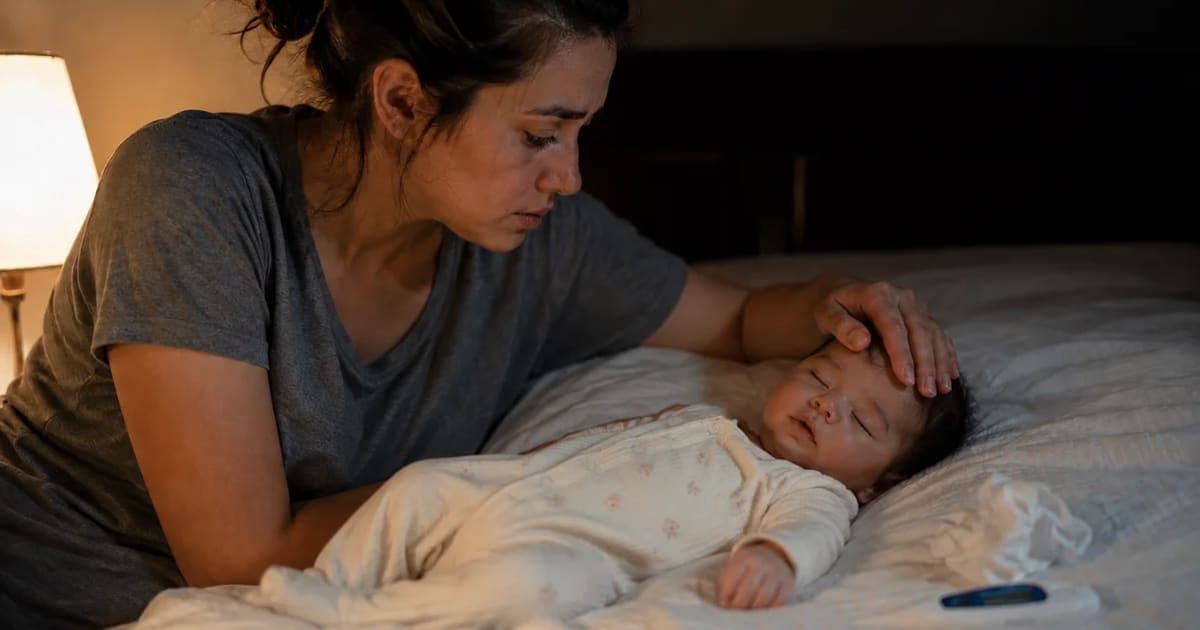
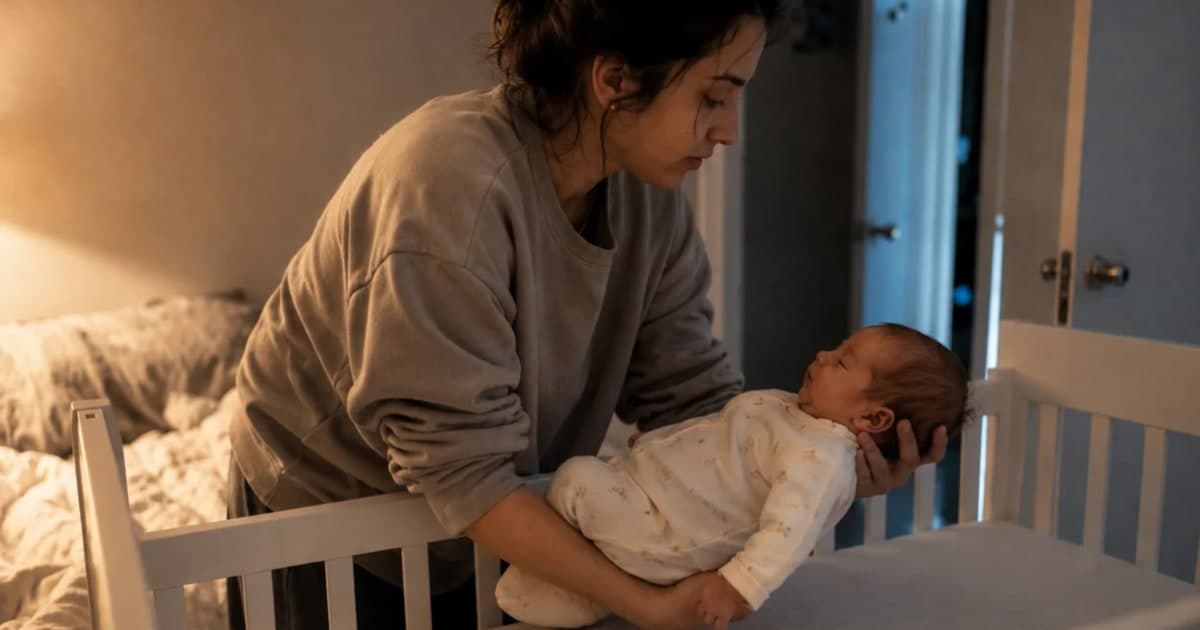
You sit down, hold your breath, and lower your sleeping baby into the crib. For three seconds, it feels like a victory. Then the eyes fly open, the limbs startle, and the crying begins. You pick them up, and within thirty seconds, they are back in a peaceful slumber on your chest.
This nightly cycle is one of the most exhausting realities of early parenting. It leaves you staring at the ceiling at 3 a.m. If your baby will only sleep when held, this preference is normal and healthy.
The biological drive that makes a baby prefer sleeping while held is normal and healthy. Recognizing the exact reasons behind this preference — and learning the mechanical steps of a successful crib transfer — is what actually helps you break the pattern without relying on rigid sleep-training programs.
Quick Summary: Crib Transition Milestones
- Understand active sleep: Newborns spend 50% of sleep in active REM. Wait 20 minutes before transfer.
- Bypass startle reflex: Lower baby feet-first, then bottom, and settle their head last.
- Gradual step-down: Shift from chest naps to lap naps, then touched transfers, before independent sleep.
- Safe boundaries: Never fall asleep holding baby on a couch. Crib sheet should stay completely empty.
Why Your Baby Will Only Sleep When Held: The Biology of Closeness
For nine months, your baby lived in a warm, dark, fluid-filled environment. They were constantly rocked by your movements, enveloped by a snug space, and comforted by the continuous rhythm of your heartbeat. Birth changes everything. Suddenly, they are placed in a spacious, stationary crib with cool sheets and unfamiliar sounds.
The first three months postpartum are widely described by pediatricians as the "fourth trimester." During this period, infants do not have the cognitive ability to self-soothe. They rely entirely on proximity to a caregiver to regulate their body temperature, heart rate, and stress levels.
The American Academy of Pediatrics recommends that infants sleep on their backs on a firm, flat, separate surface free of soft bedding to prevent Sudden Infant Death Syndrome. While contact napping is developmentally normal, falling asleep with an infant on a couch or armchair increases the risk of sleep-related infant death by up to 67-fold. Moving the baby to a compliant sleep space before you feel drowsy is the single most important safety boundary for sleep-deprived caregivers.
This biological bond is reinforced by scent. Infants have a highly developed sense of smell and can identify their mother's breast milk and skin odor within days of birth. When laid down, the sudden absence of your scent triggers a biological threat response. Their brain interprets the separation as isolation, prompting them to wake up and cry for safety.
The Science of the Crib Transfer: Why Baby Wakes Up When Put Down
Most parents make the mistake of attempting the transfer too early. They see the baby's eyes close, wait five minutes, and assume it is safe to lay them down. This timing almost always guarantees a wake-up because of infant sleep cycles.
Research published in the journal Pediatrics shows that infants spend approximately 50 percent of their sleep in active REM cycles, compared to just 20 percent for adults. Active sleep is marked by rapid eye movements, twitching, and vocalizations, making infants highly susceptible to waking during sudden changes in posture. Caregivers who wait at least 20 minutes for the infant to transition into quiet, non-REM sleep have a significantly higher rate of successful crib transfers.
The Moro reflex is a primitive protective response present in all healthy infants from birth until about 4 to 6 months of age. When the brain senses a sudden change in position or a loss of support, it interprets this as falling. The baby's arms fling outward, their back arches, and they startle awake in a panic. If you lower a baby head-first into a crib, their vestibular system registers the downward tilt of the head immediately, firing the startle reflex. Keeping their head level and lowering their body flat is a reliable way to bypass this trigger.
The Chest-to-Crib Transfer: How to Put Baby Down Without Waking
Here is the exact mechanical sequence to move your sleeping baby from your chest to the crib without triggering the startle reflex:
- Wait for deep sleep. Check the limp-limb sign by lifting your baby’s arm gently; if it drops without resistance and their breathing is slow and shallow, they are in deep sleep.
- Warm the sheets. Place a warm water bottle or a heating pad on the crib sheet for a few minutes before the transfer, removing it completely before laying the baby down so the sheet is warm but not hot.
- Keep chest-to-chest contact. Lean over the crib slowly, keeping your chest pressed against your baby's body for as long as possible during the descent to maintain warmth and proximity cues.
- Land feet-first. Lower your baby’s bottom and feet to touch the mattress first, keeping their head and upper torso angled slightly upward in your hands.
- Settle the head last. Gently lower the back of their head onto the mattress once their lower body is fully supported and stationary.
- Apply pressure. Keep your hand flat on your baby's chest and another on their hips for 30 to 60 seconds, providing a reassuring weight while you slowly slide your body back.
- Slide away slowly. Lift your hands away one millimeter at a time, moving into the shadows of the room without making sudden sounds or movements.
The Contact Nap Step-Down Plan: Moving from Arms to Crib
If your baby is accustomed to sleeping only when held, trying to transition them to the crib for all sleep times at once will result in frustration. You need a gradual step-down approach. This framework allows your baby’s nervous system to adapt to less contact over time.
| Level | Description | Key Practice |
|---|---|---|
| Level 1: The Chest Nap | The baby sleeps fully on your chest. | Caregiver must remain awake and upright in a safe chair. |
| Level 2: The Lap Transition | Baby sleeps next to you on a firm sofa or bed. | Keep your hand on their belly while you remain awake next to them. |
| Level 3: The Touch Transfer | Transfer baby to crib when asleep. | Keep hand resting firmly on their chest, lifting it gradually. |
| Level 4: Independent Sleep | Place baby in crib drowsy but awake. | Use white noise, dark room, and brief voice comfort. |
Allow your baby to spend three to five days at each level before moving to the next. If they struggle with a step, revert to the previous level for one day. This gradual process reduces stress for both of you and helps build confidence in their sleep space. As your baby clears the fourth trimester, structuring these independent crib stretches around age-appropriate wake windows becomes much easier — our 5 month old sleep schedule guide walks through how to balance daytime naps and nighttime sleep routines.
Understanding Sleep Associations: Help or Hindrance?
A sleep association is any environmental cue that a baby's brain links with falling asleep. Common associations include rocking, nursing, sucking on a pacifier, white noise, a dark room, or being held. These associations are not inherently bad. They become a challenge when they require your active presence to sustain sleep.
To help your baby sleep independently, you must transition them from active sleep associations (holding, rocking, feeding to sleep) to passive sleep associations (white noise, dark room, sleep sack, flat mattress). Introduce these passive cues during your pre-sleep routine. A high-quality white noise machine masks household sounds and keeps them asleep when quiet stretches arrive. Ensure the room is completely dark to prevent visual stimulation during light sleep cycles.
Safe Sleep Realities vs. Diaspora Cultural Pressures
For parents in South Asian, Arab, and broader immigrant communities, managing infant sleep involves more than just reading pediatrician brochures. It means managing a dense network of family expectations and traditional practices. In many diaspora households, co-sleeping (sharing a bed) is the cultural standard, often referred to in Urdu or Hindi as saath sona. Extended family members — especially grandmothers and aunts — may look at an empty crib and criticize parents for being clinical or spoiling the baby with independence.
Traditional devices like the jhoola (a hanging cloth hammock) or ghodiyu (a wooden baby swing) are commonly used to rock babies to sleep. While culturally cherished, the AAP and modern safety organizations warn against these because they lack a flat, firm surface, increasing the risk of positional asphyxia and SIDS. You do not need to choose between family harmony and safety. When managing advice from elders, use polite but firm scripts that deflect blame onto professional guidance.
Instead of arguing, say: "The pediatrician checked her growth and gave us a strict rule to keep the crib completely empty to protect her breathing. We want to make sure we follow the doctor's safety guidelines exactly." If family members insist on holding the baby to sleep, let them — provided they remain awake. Contact napping with a grandparent is a beautiful bonding opportunity, but the parent must ensure the caregiver understands the danger of falling asleep on a couch or recliner.
If you are tracking your child's growth and development through these early milestones, Nurturepedia's Child Height Predictor can give you a long-range projection based on family metrics, showing how this sleep-deprived infant stage fits into a much larger growth journey.
Sources
- American Academy of Pediatrics (HealthyChildren.org) — A Parent's Guide to Safe Sleep
- Mayo Clinic — Baby Sleep: Help Your Baby Sleep Through the Night
- Cleveland Clinic — Infant Sleep Cycles and Sleep Needs
- National Institutes of Health (NIH) — Sleep Proximity and Regulatory Development in Infants
This article is for informational purposes and does not replace medical advice. Talk to your pediatrician about baby sleep concerns, Moro reflex patterns, signs of sleep disorders, or safety questions.